Circuit length
5.412 km
Miami Grand Prix · USA
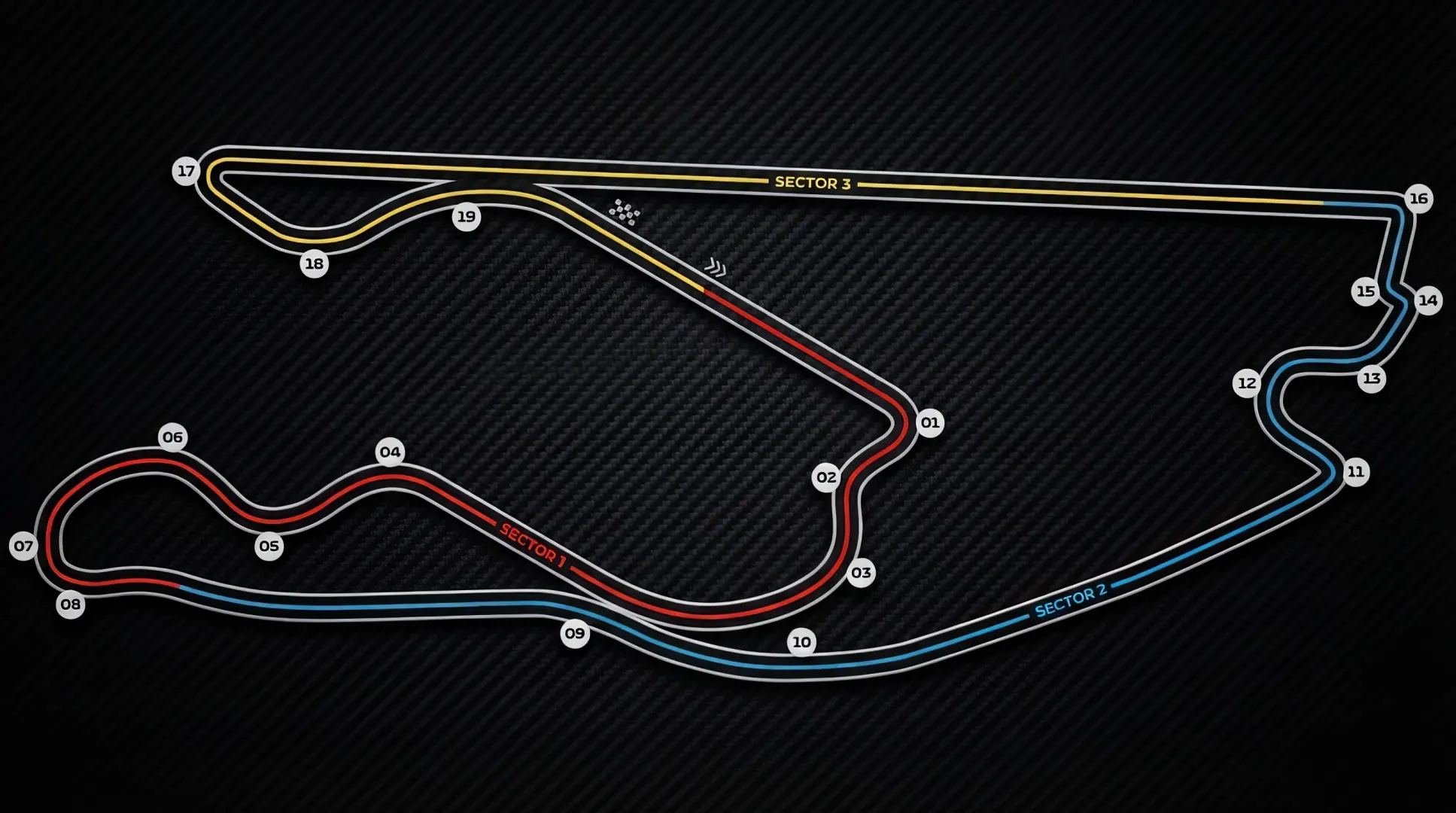
The Miami F1 circuit is a 5.412 km temporary track with 19 corners around Hard Rock Stadium in Miami Gardens. Its layout combines a fast opening sector, long straights, major braking zones and a slower technical sequence, giving the Miami Grand Prix several distinct challenges within one lap.
F1 circuit guide
Miami International Autodrome is a Formula 1 circuit in USA associated with the Miami Grand Prix. Its key figures include a 5.412 km layout, 19 turns, 57 race laps, and 0 metres of elevation change. This guide covers track statistics, lap records, famous corners, iconic Grand Prix moments, and Formula 1 history.
Compare the circuit length, turns, race distance, lap and pole records, driver wins, and elevation details for this Formula 1 track.
5.412 km
19
57
1:29.708
Max Verstappen
Fastest Q3 lap that secured Grand Prix pole on the applicable layout.
1:26.204
Max Verstappen
Max Verstappen
2 wins
0 m
Racing challenge
Miami opens with a flowing sequence where drivers need confidence, a clean line and careful use of the kerbs. The lap then changes character around the stadium. Turns 11 to 16 are slower and more intricate, with elevation changes near the highway ramps and a tight chicane that rewards patience and accurate placement. A poor exit from this section carries a lasting cost because the following straight is one of the longest on the circuit.
The long acceleration zones lead into heavy braking at Turns 11 and 17, creating the clearest opportunities to pass while also increasing the risk of lock-ups. Teams must find a balance between low-speed grip for the technical middle sector and efficient speed along the straights. Although Miami is assembled as a temporary venue, its varied layout has the feel of a permanent circuit in several sections. Track evolution over the weekend can also be significant, so drivers and engineers must keep adapting braking points, balance and tyre use as grip builds.
That mixture creates consequences across sector boundaries. Extra downforce can help through the opening sweepers and stadium complex, but efficiency still matters before the major braking zones. Drivers who keep the car tidy through the slow sequence are better placed to attack down the following straight, linking precision in the technical section directly to race opportunities.
Follow the key corner sequences in lap order and see where drivers gain time, protect momentum and create passing opportunities.
Turn 1
The first corner follows a short run from the grid and can create an early passing opportunity before the circuit accelerates into its fast opening sequence.
Turns 2 to 5
A quick series of direction changes rewards a clean line and careful kerb use. Running off line can cost grip and momentum through the sequence.
Turns 6 to 8
The long left-hand sequence loads the front-right tyre, while the exit determines speed along the acceleration zone that follows.
Turn 11
Heavy braking at the end of a long straight creates one of Miami's clearest overtaking opportunities and begins the slower stadium section.
Turns 14 and 15
The circuit climbs into a tight chicane and drops away on exit. Patience and precise placement are important before acceleration resumes.
Turn 17
A long straight ends at a slow left-hander where late braking can create an attack, but lock-ups carry a large penalty.
2026 race guide
DRS was replaced by Overtake Mode for 2026. Miami uses Straight Mode after Turn 8 toward Turn 11, after Turn 16 toward Turn 17, and on the start and finish straight toward Turn 1.
The Overtake Detection line is between Turns 17 and 18, with activation available on the following lap. The heavy braking zones at Turns 11 and 17 remain the strongest passing opportunities, while Turn 1 can also produce moves after a good final-corner exit.
A notoriously tight, slow, and undulating chicane that climbs under the Turnpike overpass, demanding extreme precision and often disrupting a driver's rhythm.
A sharp left-hand hairpin at the end of the 1.28 km (0.8 mi) back straight, serving as the circuit's primary overtaking opportunity.
A fast, sweeping left-hander that requires a crucial exit to maximize speed down the long back straight and set up a pass into Turn 17.
After 110 starts, the McLaren driver capitalized on a perfectly timed mid-race Safety Car to make a pit stop and seize the lead from the dominant Max Verstappen. Following the restart, Norris showcased stunning pace, pulling away from the Red Bull to secure an emotional and popular first win. The victory was a major breakthrough for both Norris and the resurgent McLaren team, marking a memorable upset in the sport.
 Watch iconic moment on YouTube
Miami International Autodrome brought Formula 1 to Miami Gardens in 2022 on a temporary course around Hard Rock Stadium. The track was resurfaced before the 2023 race.
The Miami International Autodrome represents Formula One's bold gambit to establish a permanent foothold in the American sporting landscape. Built around the iconic Hard Rock Stadium in Miami Gardens, Florida, this purpose-built temporary circuit embodies the sport's evolution toward spectacular entertainment venues designed to capture new audiences while delivering high-speed racing action.
The concept of bringing Formula One to Miami emerged from Liberty Media's broader strategy to expand the sport's presence in the United States following their acquisition of Formula One in 2017. American executives, led by Sean Bratches and later Stefano Domenicali, recognized that success in the U.S. market required more than simply adding races – it demanded creating events that resonated with American sporting culture.
Initial discussions centered on a street circuit in downtown Miami, similar to the Monaco Grand Prix model. Early proposals included routes through the city's financial district, past iconic landmarks like the American Airlines Arena and along Biscayne Bay. These plans generated significant excitement but also substantial opposition from local residents and businesses concerned about traffic disruption and noise.
The downtown Miami concept faced insurmountable logistical and political challenges. Local opposition groups organized effectively against the proposed street closures, while the complexity of securing permits across multiple municipal jurisdictions proved prohibitive. By 2019, Formula One officials acknowledged that alternative solutions were necessary to bring racing to South Florida.
The breakthrough came through discussions with Stephen Ross, owner of the Miami Dolphins and Hard Rock Stadium. Ross, a longtime motorsport enthusiast, recognized the potential synergy between Formula One and his entertainment complex. The stadium had already established itself as a multi-purpose venue hosting Super Bowls, college football playoffs, and major concerts.
Hard Rock Stadium's location in Miami Gardens provided several advantages over downtown alternatives. The venue offered extensive parking, established security infrastructure, and proximity to major highways without requiring street closures in residential areas. The stadium's existing hospitality facilities and corporate partnerships created a foundation for the premium experiences Formula One sought to deliver.
The partnership announcement in April 2021 revealed plans for a circuit built around the stadium's perimeter, incorporating the facility's parking areas and utilizing temporary track sections. This approach allowed Formula One to create a purpose-built racing environment while leveraging existing infrastructure and minimizing community disruption.
The Miami International Autodrome was designed by Formula One's circuit architecture team led by Tilke Engineers & Architects, working in collaboration with local engineering firms familiar with South Florida's unique environmental challenges. The 5.41-kilometer circuit features 19 corners and incorporates significant elevation changes despite Florida's generally flat topography.
The track layout utilizes the natural contours around Hard Rock Stadium, creating elevation changes of up to 18 meters between the highest and lowest points. This variation adds complexity to car setup and creates opportunities for different racing lines and overtaking possibilities.
The circuit's most distinctive feature is its passage around and partially through the stadium complex. Turn 7, known as the Stadium Section, brings cars within meters of the venue's exterior walls, creating unique acoustic effects and spectacular viewing opportunities for spectators in the stadium's upper levels.
Engineering the temporary circuit required innovative solutions for South Florida's challenging climate. The concrete barriers and track surface were designed to withstand extreme heat, humidity, and potential weather events including thunderstorms and hurricanes. Drainage systems were engineered to handle the region's intense rainfall while maintaining racing safety standards.
Construction of the Miami International Autodrome began in January 2022, with an ambitious timeline to complete the circuit for the inaugural race in May. The project required coordinating with ongoing stadium operations, including Miami Dolphins activities and other scheduled events.
The track surface itself presented unique challenges. While utilizing existing roadways where possible, significant portions required new asphalt specifically designed for Formula One racing. The surface mixture was formulated to provide optimal grip while withstanding Florida's extreme temperatures and UV exposure.
Temporary grandstands capable of accommodating over 80,000 spectators were constructed around key viewing areas. The main grandstand, positioned along the start/finish straight, featured premium hospitality facilities and climate-controlled areas essential for comfort in Miami's tropical climate.
The paddock complex was built as a temporary but sophisticated facility, featuring team garages, hospitality areas, and media centers that met Formula One's exacting standards. Climate control systems were essential throughout these facilities to maintain equipment performance and human comfort in the challenging environment.
The first Miami Grand Prix took place on May 6-8, 2022, generating enormous anticipation and media attention. The event was positioned as a cultural phenomenon beyond traditional motorsport, featuring extensive entertainment programming, celebrity appearances, and luxury experiences designed to appeal to American audiences.
The race weekend began with concerns about track surface conditions, as the new asphalt provided limited grip during practice sessions. Teams struggled with car setup as the track evolved rapidly throughout the weekend, creating uncertainty about optimal racing strategies.
Qualifying saw Charles Leclerc claim pole position for Ferrari, setting a new track record on the virgin circuit. The competitive order reflected the challenging nature of learning a completely new venue under time pressure, with several drivers experiencing difficulties adapting to the track's unique characteristics.
The inaugural race itself proved entertaining for spectators, with Max Verstappen emerging victorious after overtaking Leclerc early in the race. The event featured multiple lead changes, strategic intrigue, and close racing throughout the field. The race distance of 57 laps provided sufficient time for tire strategies to develop while maintaining excitement for television audiences.
The Miami International Autodrome presents drivers with a unique combination of high-speed sections and technical challenges. The main straight, running alongside Hard Rock Stadium, provides the circuit's primary overtaking opportunity with DRS activation creating speed differentials exceeding 15 kilometers per hour.
The circuit's first sector features a series of medium-speed corners that reward precise car balance and aerodynamic efficiency. The elevation changes through this section affect car handling and require specific suspension setups to maintain optimal performance.
The middle sector includes the circuit's most technically demanding corners, with the chicane complex at Turns 14-15 creating opportunities for late-braking overtakes while punishing driver errors. This section tests both driver skill and car mechanical grip, often determining lap time differences.
The final sector's flowing nature allows for high-speed approaches to the start/finish straight, creating opportunities for slipstream battles and strategic positioning for overtaking attempts. The sector's design rewards brave late-braking while providing sufficient run-off areas for safety.
Miami's tropical climate presents unique challenges for Formula One participants. Ambient temperatures regularly exceed 30°C during race weekends, with humidity levels often approaching 80%. These conditions create extreme stress on both human participants and mechanical equipment.
Track surface temperatures can exceed 60°C during afternoon sessions, affecting tire performance and strategy significantly. Teams must adapt cooling systems, driver hydration protocols, and equipment management to cope with the extreme conditions.
The threat of afternoon thunderstorms adds unpredictability to race weekends. South Florida's weather patterns can change rapidly, creating strategic challenges and safety considerations that don't exist at most other Formula One venues.
The Miami International Autodrome was designed with spectator experience as a primary consideration. The circuit's integration with Hard Rock Stadium allows for unique viewing experiences, including watching practice sessions from stadium seats with elevated perspectives of the entire track.
The venue's entertainment programming extends far beyond racing, featuring concerts by major artists, celebrity appearances, and extensive hospitality offerings. This approach reflects Formula One's strategy to attract audiences who might not traditionally attend motorsport events.
The marina section, featuring artificial water features and luxury boat displays, creates a Miami Vice-inspired atmosphere designed to appeal to the city's cultural identity. These aesthetic elements serve both as spectator amenities and television backdrops that reinforce the event's unique character.
Climate-controlled hospitality areas throughout the venue provide essential respite from South Florida's challenging weather conditions while offering premium viewing experiences for corporate guests and VIP ticket holders.
The Miami Grand Prix generates substantial economic impact throughout South Florida, with estimates suggesting over $400 million in regional economic activity during race weekend. Hotel occupancy rates reach capacity throughout Miami-Dade County, while restaurants, attractions, and retail establishments benefit from increased tourism.
The event has also created ongoing economic benefits through job creation, infrastructure improvements, and increased international awareness of Miami as a premium destination. The global television audience exceeding 300 million viewers provides marketing value that extends far beyond the race weekend itself.
Community relations have generally been positive, particularly compared to the opposition faced by the original downtown Miami proposal. The use of Hard Rock Stadium's existing infrastructure minimized disruption to residential areas while providing economic benefits to Miami Gardens and surrounding communities.
The Miami International Autodrome incorporates numerous technical innovations designed to enhance both racing quality and safety. The circuit's barrier systems utilize the latest energy-absorbing technologies, while extensive run-off areas provide drivers with recovery options following mistakes.
The track's surface monitoring systems provide real-time data about grip levels, temperature variations, and wear patterns. This information helps race officials make informed decisions about safety conditions while providing teams with valuable setup data.
Advanced weather monitoring systems are particularly crucial in Miami's challenging climate. Radar systems capable of tracking approaching storms allow officials to make proactive decisions about session delays or modifications.
The circuit's temporary nature requires innovative solutions for utilities, communications, and safety systems that can be rapidly installed and removed while maintaining permanent facility standards during racing operations.
The Miami International Autodrome was designed with television production as a fundamental consideration. Camera positions throughout the circuit provide dramatic angles showcasing both the racing action and the unique South Florida setting.
The circuit's aesthetic elements, including palm trees, water features, and the stadium backdrop, create visually distinctive footage that differentiates Miami coverage from other Formula One venues. These elements serve Formula One's broader goal of creating unique visual identities for each race.
Broadcasting infrastructure includes fiber optic networks capable of supporting Formula One's extensive global television requirements. The temporary nature of much infrastructure required innovative solutions for maintaining broadcast quality while accommodating rapid installation and removal schedules.
The Miami International Autodrome faced several challenges during its early years. Track surface evolution remained a concern through multiple race weekends, with grip levels varying significantly between sessions and creating unpredictable conditions for teams and drivers.
Some traditional Formula One fans criticized aspects of the event's entertainment focus, arguing that excessive emphasis on celebrity culture and non-racing activities detracted from the sporting competition. These concerns reflected broader debates about Formula One's evolution toward mainstream entertainment.
Environmental concerns about the temporary circuit's impact on local ecosystems prompted discussions about sustainability measures and long-term environmental planning. Organizers committed to carbon offset programs and sustainable practices to address these issues.
Following the inaugural event, circuit organizers implemented several improvements based on feedback from teams, drivers, and spectators. Track surface modifications aimed to improve grip consistency, while minor layout adjustments sought to enhance overtaking opportunities.
Spectator facility improvements focused on crowd flow management, concession availability, and transportation logistics. The extreme popularity of the inaugural event created capacity challenges that required systematic solutions for subsequent years.
The paddock and garage facilities underwent refinements to improve functionality and climate control. Teams provided detailed feedback about equipment performance in Miami's challenging conditions, leading to infrastructure modifications for future events.
The Miami Grand Prix has significantly influenced Formula One's profile in American popular culture. The event's integration with entertainment and celebrity culture has introduced the sport to audiences who might not otherwise engage with motorsport.
Social media engagement around the Miami race consistently exceeds most other Formula One events, reflecting the venue's success in appealing to younger, more diverse audiences. This engagement translates into broader interest in Formula One throughout the American market.
The race's success has influenced other American venues and cities to pursue Formula One events, creating competitive pressure that benefits the sport's overall growth in the United States.
The Miami International Autodrome is contracted to host Formula One through 2031, providing long-term stability for the sport's American expansion strategy. This extended commitment allows for continued investment in circuit improvements and facility development.
Discussions about permanent infrastructure elements continue, potentially including permanent paddock facilities, grandstands, or track sections that would reduce annual construction costs while improving facility quality.
The circuit's success has sparked interest in additional American Formula One venues, creating the possibility of multiple U.S. races that could establish Formula One as a significant presence in the American sporting landscape.
The Miami International Autodrome represents more than just another Formula One circuit – it symbolizes the sport's successful adaptation to new markets and cultural contexts. The venue's unique combination of high-quality racing, entertainment spectacle, and cultural integration provides a template for Formula One's continued global expansion.
The circuit's ability to generate substantial economic impact while creating compelling racing action demonstrates Formula One's potential to serve as both sporting competition and economic development catalyst. This dual role may influence how other cities and regions approach major sporting event development.
As Formula One continues evolving toward broader entertainment appeal while maintaining its core sporting integrity, the Miami International Autodrome stands as evidence that this balance can be achieved successfully. The venue's ongoing success will likely influence Formula One's approach to future venue development and cultural integration efforts worldwide.
The story of the Miami International Autodrome reflects Formula One's ambitions and adaptability in the 21st century, showcasing how the sport can honor its racing heritage while embracing new opportunities for growth and cultural relevance.
Miami International Autodrome is a temporary circuit built around the Hard Rock Stadium complex. It has street-circuit characteristics, but its purpose-designed layout is intended to feel like a permanent track.
Miami International Autodrome is 5.412 km long and has 19 corners. The Miami Grand Prix runs for 57 laps, covering 308.326 km.
The major braking zones at Turns 11 and 17 offer the clearest passing chances after long acceleration sections. Turn 1 can also create opportunities at the start or after a strong run onto the main straight.