Circuit length
5.513 km
United States Grand Prix · USA
F1 circuit guide
Circuit of the Americas is a Formula 1 circuit in USA associated with the United States Grand Prix. Its key figures include a 5.513 km layout, 20 turns, 56 race laps, and 41 metres of elevation change. This guide covers track statistics, lap records, famous corners, iconic Grand Prix moments, and Formula 1 history.
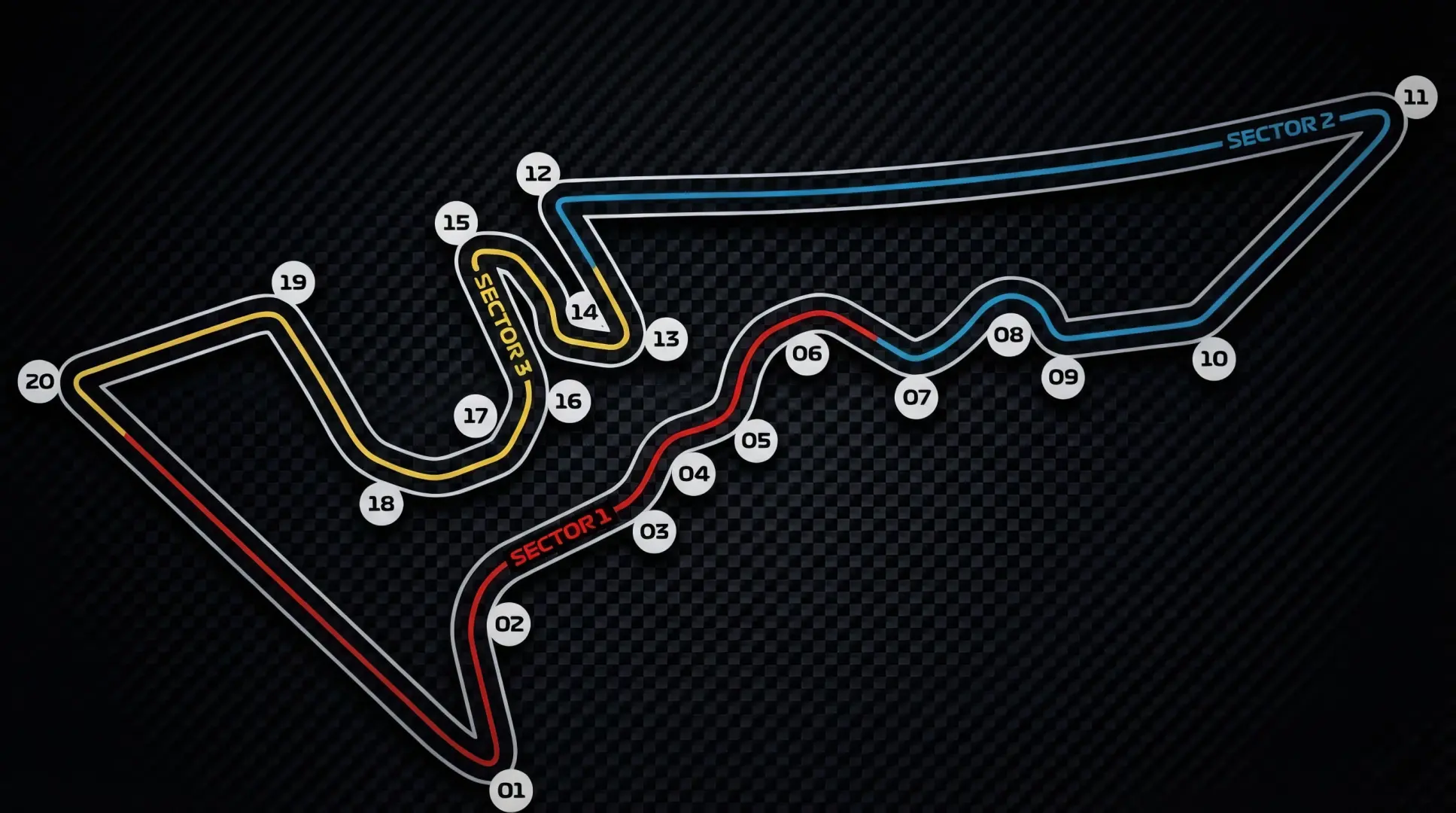
Compare the circuit length, turns, race distance, lap and pole records, driver wins, and elevation details for this Formula 1 track.
5.513 km
20
56
1:36.169
Charles Leclerc
Fastest Q3 lap that secured Grand Prix pole on the applicable layout.
1:32.029
Valtteri Bottas
Lewis Hamilton
5 wins
41 m
A massive, blind uphill climb into a sharp left-hand hairpin, a truly unique first corner.
A high-speed sequence of esses inspired by the famous section at Silverstone.
In a chaotic wet-dry race full of action and mistakes, Lewis Hamilton secured his third World Championship after a late-race error from his teammate Nico Rosberg.
 Watch iconic moment on YouTube
The Circuit of the Americas (COTA) emerged from the ambitious vision of American businessman Tavo Hellmund and Texas billionaire Red McCombs, who initially conceived a racing facility called "Speed City" before ultimately settling on the Circuit of the Americas name. In a news conference on July 27, 2010, Tavo Hellmund announced plans to build the track on approximately 890 acres of undeveloped land in southeastern Travis County, near Austin, Texas. The majority of the site had been previously planned for development into a residential subdivision called "Wandering Creek."
This project represented something unprecedented in American motorsports: the first circuit in the United States to be purpose-built specifically for Formula One racing. Both the race and the circuit were proposed by promoter Tavo Hellmund in collaboration with World Champion motorcyclist Kevin Schwantz, with assistance provided by the Hermann Tilke group.
The circuit design was a collaborative effort between HKS, Inc. and Tilke Engineers & Architects, with the main grandstand and feature observation tower and amphitheatre being designed by Austin architectural firm, Miró Rivera. The circuit homologation design was submitted to the FIA in Geneva for approval on December 17, 2010, marking a crucial milestone in bringing Formula One back to the United States.
The track's design incorporated a sophisticated blend of high-speed straights, tight hairpins, and sweeping curves, drawing inspiration from some of the world's most iconic racing circuits. This approach aimed to create a challenging and exciting venue that would meet the demanding standards of Formula One while also being suitable for other major motorsports series.
Construction began on December 31, 2010, with an initial completion target of June 2012. The project faced significant challenges from the outset, including the site's location in a floodplain and the need to upgrade nearby infrastructure to support a world-class racing facility. Following a stop-work order in December 2011, the completion date was revised to August 2012.
The early construction phases involved building silt fences, taking core samples, and clearing existing vegetation from the site. To meet the commitment to Formula One to host the U.S. Grand Prix in 2012, the facility was designed and built on an accelerated basis in less than two years. Despite numerous weather delays and logistical challenges, approximately 1,200 craftsmen and laborers maintained a twenty-hour daily work schedule to keep the project moving forward.
Advanced construction techniques were employed throughout the project, including sophisticated GPS-based 3D paving technology to meet the stringent FIA Grade 1 standards required for Formula One racing. The first layer of asphalt was completed on August 3, 2012, with laying of the final layer commencing on August 14 and finishing on September 21, 2012.
The Circuit of the Americas officially opened on October 21, 2012, in a ceremony that perfectly captured the significance of the moment for American motorsports. Racing legend Mario Andretti, the 1978 Formula One World Champion, had the honor of completing the first-ever laps on the new circuit, driving his championship-winning Lotus 79. This symbolic opening marked the end of a seven-year absence of Formula One from American soil.
The opening ceremony represented not just the completion of a construction project, but the realization of a dream to bring world-class motorsports back to the United States with a purpose-built facility designed to the highest international standards.
The inaugural United States Grand Prix at Circuit of the Americas took place on November 18, 2012, serving as the penultimate round of the 2012 Formula One season. This historic race marked the return of Formula One to the United States after a five-year absence since the last race at Indianapolis in 2007. The event exceeded all expectations, with over 100,000 spectators packing the facility.
Sebastian Vettel, the reigning world champion, started on pole position for Red Bull Racing, but it was Lewis Hamilton, driving for McLaren, who delivered a memorable performance that captivated the American audience. The success of this inaugural race firmly established COTA as a permanent fixture on the Formula One calendar.
Building on its Formula One success, COTA quickly expanded its racing portfolio. MotoGP first raced at the circuit on April 21, 2013, adding another premier international motorsports series to the venue's calendar. The circuit's design proved equally well-suited to motorcycle racing, with its mix of technical corners and high-speed sections providing exciting racing for two-wheeled competition.
The facility has since welcomed additional major racing series, including NASCAR, which brought America's premier stock car racing series to the road course format. This diversification has helped establish COTA as a true multi-purpose motorsports destination.
Beyond the racing circuit itself, COTA developed into a comprehensive entertainment complex. The venue features an iconic observation tower that has become a distinctive landmark of the Austin skyline, offering spectacular views of the circuit and surrounding Hill Country. The Germania Insurance Amphitheater adds a major concert venue to the complex, hosting world-class musical performances throughout the year.
Additional facilities include COTA Karting, providing grassroots racing opportunities, and extensive hospitality and event spaces that serve the venue year-round. This comprehensive approach has made COTA not just a racing venue, but a destination for entertainment and events of all kinds.
The Circuit of the Americas has fundamentally changed the landscape of American motorsports since its opening in 2012. It proved that the United States could support a world-class, purpose-built racing facility that meets the highest international standards. The circuit's success in attracting and retaining major racing series has helped elevate Austin's profile as an international destination and contributed significantly to the local economy.
COTA's model of combining motorsports with entertainment and hospitality has influenced venue development across the motorsports industry. The circuit stands as a testament to what can be achieved when vision, investment, and execution come together in pursuit of motorsports excellence.
From its origins in the ambitious dreams of Tavo Hellmund and Red McCombs to its current status as one of America's premier motorsports destinations, the Circuit of the Americas represents a remarkable achievement in just over a decade of operation. The venue continues to evolve and expand its offerings, ensuring its place as a cornerstone of international motorsports for years to come.