Circuit length
5.793 km
Italian Grand Prix · Italy
F1 circuit guide
Monza Circuit is a Formula 1 circuit in Italy associated with the Italian Grand Prix. Its key figures include a 5.793 km layout, 11 turns, 53 race laps, and 13 metres of elevation change. This guide covers track statistics, lap records, famous corners, iconic Grand Prix moments, and Formula 1 history.
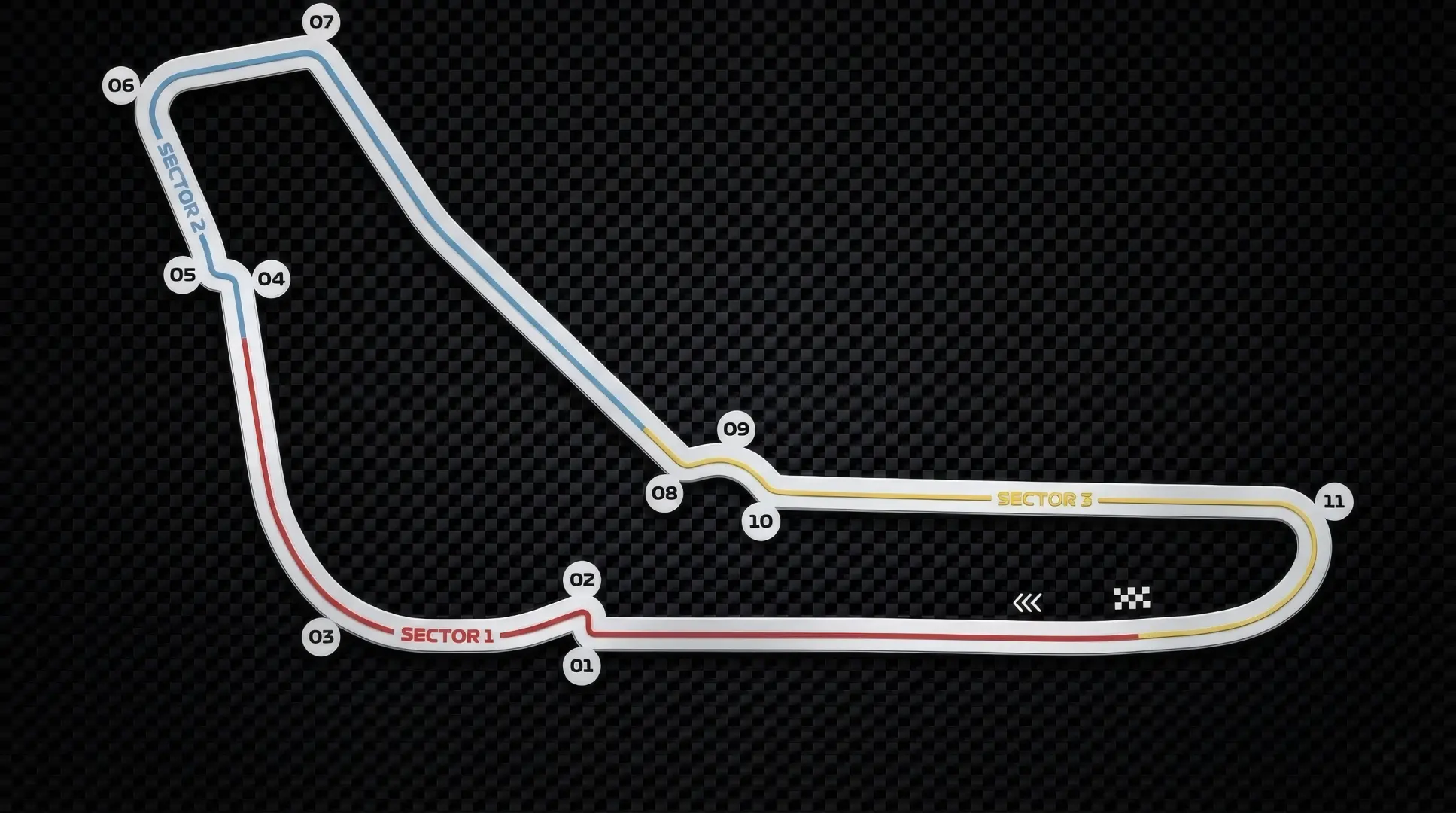
Compare the circuit length, turns, race distance, lap and pole records, driver wins, and elevation details for this Formula 1 track.
5.793 km
11
53
1:20.901
Lando Norris
Fastest Q3 lap that secured Grand Prix pole on the applicable layout.
1:18.792
Max Verstappen
Lewis Hamilton/Michael Schumacher
5 wins
13 m
A long, sweeping 180-degree right-hander that is crucial for getting a good exit onto the main straight.
A high-speed left-right-left sequence that requires immense precision.
Peter Gethin won the race by just 0.01 seconds from Ronnie Peterson in a slipstream thriller where the top five finishers were covered by only 0.61 seconds.
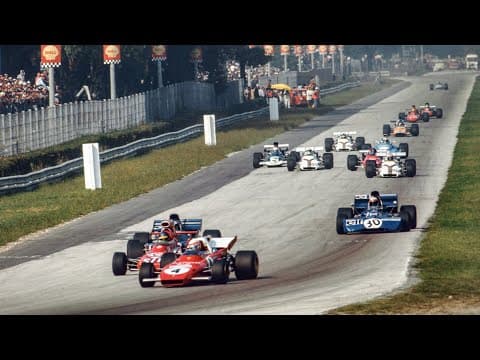 Watch iconic moment on YouTube
The Autodromo Nazionale Monza, known worldwide as the "Temple of Speed," stands as one of motorsport's most storied and dangerous venues, with a history stretching over a century of racing excellence, tragedy, and evolution.
The story of Monza begins in January 1922, when the construction of the Autodromo Nazionale Monza was decided in January 1922 by the Automobile Club of Milan, with the aim of celebrating the 25th anniversary of the birth of the Association. The first stone was laid in February 1922. However, work would be immediately suspended and there was a long debate around the "artistic, monumental and landscape conservation value".
Despite initial opposition, construction proceeded rapidly. The first track was built from May to July 1922 by 3,500 workers, financed by the Milan Automobile Club – which created the Società Incremento Automobilismo e Sport (SIAS). Constructed in just 110 days in 1922, the Autodromo Nazionale Monza was the world's third purpose-built race track, coming after Brooklands in the UK and Indianapolis in the US.
The circuit was constructed in a royal park just north of the town of Monza in the spring of 1922, in the Parco di Monza, a public city park with a largely woodland setting, where the famous Royal Villa of Monza is also located.
Monza officially opened its gates on September 3, 1922. This grand opening was strategically timed, just a week before the track hosted that year's Italian Grand Prix. The first Italian Grand Prix took place at Monza in 1922 on a 10 km combined layout, utilizing both the road course and the banked oval sections.
Like those two tracks, the original circuit featured a daunting series of banked curves, as well as much of the road course that forms the basis of today's layout. The original design was ambitious and reflected the era's fascination with high-speed racing.
The early decades of Monza were marked by both spectacular racing and tragic accidents. During the pre-war era, Monza gained notoriety for a number of fatal crashes involving both drivers and spectators. The 1933 Monza Grand Prix saw three deaths, including drivers Giuseppe Campari and Count Baconin.
These safety concerns led to modifications of the circuit. The dangerous banked oval was abandoned altogether in 1938, though it would later be rebuilt and used again in subsequent decades.
Following its first race, as part of the inaugural Formula 1 World Championship in 1950, Monza has been a constant fixture on the Formula 1 calendar. The circuit became synonymous with the Italian Grand Prix and developed its legendary status as Ferrari's home circuit.
The banked sections of Monza continued to be used selectively over the decades. Although the Monza banking was forbidden in Formula One races since 1962, it was still used for the 1000 Kilometers of Monza for sports cars. In order to improve safety, two permanent chicanes were added in 1966 for the entry into both high-speed banked corners.
Future Grands Prix were held on the shorter road circuit, with the banking appearing one last time in the film Grand Prix, immortalizing these dramatic curves in cinema before they were largely abandoned for major racing.
Throughout the decades, Monza underwent numerous safety-focused changes. Over the following decades, more chicanes were added and corner profiles were altered. Though this succeeded in slowing the cars, it did little to reduce the number of driver fatalities in the 1950s and 60s.
Major modifications included a demolition of the old banked curves. There was a slight reshaping and tightening of the Lesmo corners. The Grand Prix circuit has undergone a number of safety-targeted modifications over the years, including the addition of the Variante del Rettifilo, Variante della Roggia and Variante Ascari chicanes, but the boomerang-shaped circuit's fundamental high speed character remains unchanged.
Today, Monza remains a true cathedral to speed, unmatched around the world for its sense of history and passion, fuelled in part by its long history and also the fanaticism of the Italian fans, the tifosi. With the steadily decaying remnants of the high speed banked circuit providing a backdrop through the parkland trees, the atmosphere here is like no other; a mix of speed, melodrama and more than a hint of melancholy.
The Autodromo Nazionale Monza continues to host the Italian Grand Prix and remains one of the most challenging and atmospheric venues in Formula 1, carrying forward over a century of motorsport history while adapting to modern safety requirements. Its unique combination of high-speed straights and technical sections, set within the beautiful Parco di Monza, ensures its place as one of racing's most revered venues.