Circuit length
5.419 km
Qatar Grand Prix · Qatar
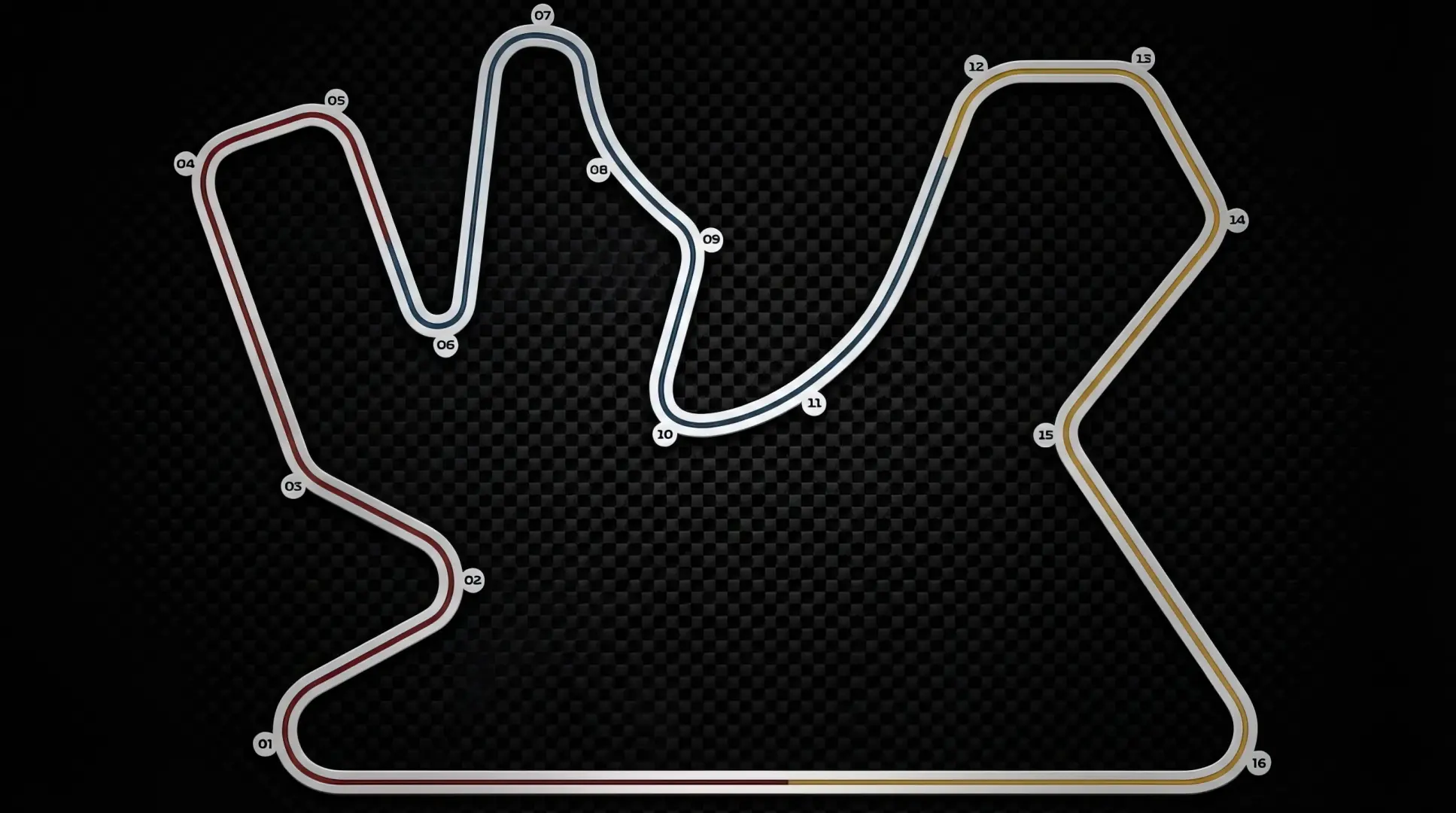
The Lusail F1 circuit is a 5.419 km, 16-turn permanent track near Doha. Its long main straight leads into the clearest braking opportunity at Turn 1, while the rest of the floodlit lap is shaped by fast, linked corners that reward rhythm and stable aerodynamic balance.
F1 circuit guide
Lusail International Circuit is a Formula 1 circuit in Qatar associated with the Qatar Grand Prix. Its key figures include a 5.419 km layout, 16 turns, 57 race laps, and 6 metres of elevation change. This guide covers track statistics, lap records, famous corners, iconic Grand Prix moments, and Formula 1 history.
Compare the circuit length, turns, race distance, lap and pole records, driver wins, and elevation details for this Formula 1 track.
5.419 km
16
57
1:22.384
Lando Norris
Fastest Q3 lap that secured Grand Prix pole on the applicable layout.
1:19.387
Oscar Piastri
Max Verstappen
3 wins
6 m
Racing challenge
Lusail was designed first for motorcycle racing, and its broad, flowing layout gives Formula 1 drivers a sequence of medium- and high-speed corners rather than repeated heavy stops. The opening sector links Turns 2 to 5 in quick succession, so a small mistake can affect several corners. Turn 6 provides a slower change of pace before the circuit builds speed again through its sweeping middle section.
The main straight is more than a kilometre long and ends at Turn 1, the circuit's clearest conventional passing opportunity. Teams still need enough downforce and stability for the fast corners, especially the sustained sequence from Turns 12 to 14. That creates a setup compromise between straight-line efficiency and confidence through the loaded sections of the lap.
Night conditions and a desert setting add another layer. Grip can develop as the weekend progresses, while drivers must remain accurate around the track edges through corners where the car carries substantial speed. A strong lap depends less on one dramatic braking point than on preserving momentum and tyre performance across the complete sequence.
Follow the key corner sequences in lap order and see where drivers gain time, protect momentum and create passing opportunities.
Turn 1
The kilometre-plus main straight ends at a right-hander that provides the lap's clearest passing opportunity and begins the flowing opening sector.
Turns 2 to 5
Linked medium-speed corners reward rhythm and a stable platform. Losing the line early can compromise the rest of the sequence.
Turn 6
The slower left-hander interrupts the circuit's high-speed flow and can offer an alternative chance to attack under braking.
Turns 9 and 10
Drivers carry speed through the kink before setting the car for the following change of direction, making exit precision important.
Turns 12 to 14
Three connected right-handers demand commitment, consistent balance and careful tyre use as lateral load builds through the sequence.
Turn 16
The last right-hander determines acceleration onto the long main straight, so a clean exit is essential for both lap time and an attack into Turn 1.
2026 race guide
DRS was replaced by Overtake Mode and Straight Mode for the 2026 season. Lusail's event-specific 2026 mode zones had not been published at this page's October 1 factual review date, so historical DRS locations are not presented as current information.
The long main straight creates the strongest conventional attack into Turn 1, while Turn 6 can offer a secondary chance under braking. The guide will be reviewed again when the FIA publishes the circuit map for the 2026 Qatar Grand Prix weekend.
A long, fast right-hander at the end of the main straight.
A demanding triple-apex right-hander that puts huge strain on drivers and tyres.
The extreme heat and humidity, combined with the high-G corners, pushed drivers to their physical limits, with several requiring medical attention after the race.
 Watch iconic moment on YouTube
Built for MotoGP in 2004, Lusail hosted Qatar's first Formula 1 Grand Prix in 2021. The venue was upgraded before Formula 1 returned in 2023, while its fast, flowing layout still reflects its motorcycle-racing origins.
Lusail International Circuit emerged from Qatar's ambitious vision to establish itself as a premier motorsports destination in the Middle East. Built in just under a year by 1,000 workers at the cost of US$58 million, the track opened in 2004 under the supervision of the Qatar Motor and Motorcycle Federation. The rapid construction timeline required almost 1,000 workers on site round-the-clock to meet the demanding deadline for the inaugural event.
Located on the outskirts of Doha, Qatar's capital city, the circuit was strategically positioned to serve as a gateway for international motorsports in the region. The design incorporated artificial grass around the track perimeter to prevent sand from the neighboring desert from interfering with racing conditions.
The track hosted the inaugural Qatar motorcycle Grand Prix in the same year, won by Sete Gibernau on October 2, 2004. This marked the beginning of what would become a long and successful partnership between Qatar and MotoGP. The circuit was specifically designed primarily with motorcycle racing in mind, featuring a fast and flowing 5.4-kilometer layout with medium and high-speed corners predominating.
The track's main straight stretches over one kilometer in length, providing excellent overtaking opportunities and high-speed racing. From its opening, Lusail established itself as a favorite among MotoGP riders and teams for its challenging yet fair layout.
A pivotal moment in the circuit's history came in 2007 when Lusail added permanent outdoor lighting for night races. This innovation transformed the venue into something truly unique in the motorsports world. The first night MotoGP race on the track took place in 2008, making Lusail International Circuit famous for hosting the first-ever night race in MotoGP history.
The introduction of night racing not only provided a spectacular visual experience but also offered practical benefits, allowing races to be held during cooler evening temperatures in Qatar's desert climate while accommodating television audiences in Europe at more convenient viewing times.
Following the successful implementation of night racing, Lusail became a cornerstone of the MotoGP calendar. Since 2004, Lusail International Circuit has been hosting this thrilling two-wheel race consistently, establishing itself as the traditional season opener for MotoGP. The Qatar Grand Prix became synonymous with the beginning of each MotoGP season, offering riders and teams their first competitive opportunity of the year.
The circuit's reputation grew steadily during this period, with its unique night racing format and challenging layout earning praise from riders, teams, and fans alike. The venue became known for producing exciting races and memorable moments in MotoGP history.
The first Qatar Grand Prix at the Lusail International Circuit took place on November 21, 2021, marking a significant milestone in the venue's history. 2021 represented the first time Qatar had ever hosted the FIA Formula One World Championship. Despite being designed primarily for motorcycle racing, the circuit adapted well to Formula 1 cars, though it presented unique challenges due to its original motorcycle-focused design.
The debut Formula 1 race was considered successful, demonstrating Qatar's capability to host more and more high-profile racing events and building on its established motorsports credentials.
After a successful debut in 2021, Qatar was absent from the 2022 race calendar, primarily due to the 2022 FIFA World Cup being held in Qatar, which required significant logistical resources and scheduling considerations.
However, Qatar's commitment to Formula 1 was reaffirmed when in 2023, the Lusail International Circuit reached an agreement with Formula 1 to extend their contract. The agreement secured the Qatar Grand Prix for 10 years, with the circuit set to host Formula 1 until 2033. This long-term commitment demonstrated both Formula 1's confidence in the venue and Qatar's dedication to maintaining its position in international motorsports.
The circuit's 5.4-kilometre layout is characterized as a fast and flowing track, where medium- and high-speed corners predominate. Over one kilometre of the circuit consists of the main straight, making it one of the longer straights on both the MotoGP and Formula 1 calendars.
Lusail International Circuit stands as a testament to Qatar's successful entry into the world of international motorsports. From its rapid construction in 2003-2004 to becoming the pioneer of night racing in MotoGP and securing a long-term Formula 1 contract, the circuit has consistently evolved to meet the demands of top-tier motorsports while maintaining its unique character and challenging layout.
The venue continues to play a crucial role in both MotoGP and Formula 1, serving as a bridge between traditional motorsports markets and the growing Middle Eastern motorsports community. Its history reflects not just the evolution of a single circuit, but also the broader transformation of Qatar into a major international sporting destination.
Lusail International Circuit is 5.419 km long and has 16 turns. The Qatar Grand Prix runs for 57 laps, producing a race distance of 308.611 km.
Turn 1 is the main passing opportunity because drivers reach it after the circuit's kilometre-plus main straight. Turn 6 can also create a chance under braking.
Lusail hosted the first Qatar Grand Prix in 2021. Formula 1 returned to the upgraded venue in 2023.