Circuit length
5.412 km
Bahrain Grand Prix · Bahrain
F1 circuit guide
Bahrain International Circuit is a Formula 1 circuit in Bahrain associated with the Bahrain Grand Prix. Its key figures include a 5.412 km layout, 15 turns, 57 race laps, and 18 metres of elevation change. This guide covers track statistics, lap records, famous corners, iconic Grand Prix moments, and Formula 1 history.
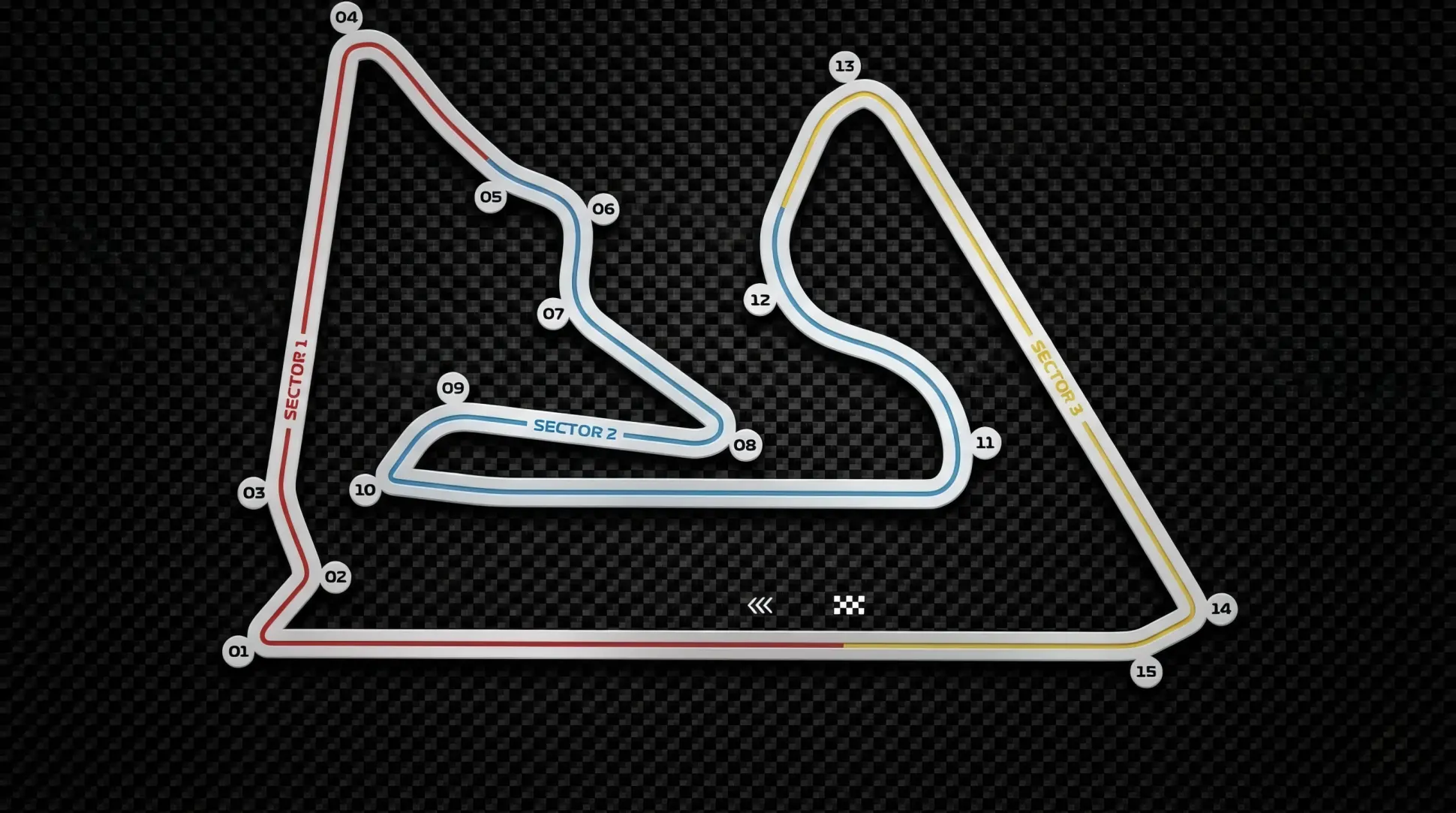
Compare the circuit length, turns, race distance, lap and pole records, driver wins, and elevation details for this Formula 1 track.
5.412 km
15
57
1:31.447
Pedro de la Rosa
Fastest Q3 lap that secured Grand Prix pole on the applicable layout.
1:27.264
Lewis Hamilton
Lewis Hamilton
5 wins
18 m
A tight, downhill, off-camber left-hander that is one of the most technically challenging corners on the circuit.
A sharp hairpin after the main straight, a key overtaking opportunity.
Romain Grosjean survived a horrific crash on the opening lap when his car split in half and burst into flames. His escape was a testament to modern F1 safety standards.
 Watch iconic moment on YouTube
The Bahrain International Circuit emerged from the ambitious vision of Crown Prince Salman bin Hamad Al Khalifa, who sought to establish Bahrain as a major destination for motorsport in the Middle East. The project began in 2002 as part of Bahrain's broader economic diversification strategy, moving away from oil dependency toward tourism and entertainment.
German architect Hermann Tilke, renowned for designing modern Formula 1 circuits, was commissioned to create the track. The circuit was built in the Sakhir desert, approximately 30 kilometers south of Bahrain's capital, Manama. Construction took just over two years and cost approximately $150 million, making it one of the most expensive circuit projects of its time.
The facility was designed to meet the highest international motorsport standards, featuring state-of-the-art safety systems, pit facilities, and spectator amenities. The main grandstand could accommodate 12,000 spectators, with additional temporary seating bringing total capacity to around 50,000 for major events.
The Bahrain International Circuit made history on April 4, 2004, hosting the inaugural Bahrain Grand Prix. This event marked a significant milestone as the first Formula 1 race held in the Middle East, opening a new chapter in the sport's global expansion. Michael Schumacher, driving for Ferrari, won the debut race, cementing his dominance during that era.
The circuit's unique desert setting created distinctive challenges for drivers and teams. The sandy environment led to grip issues as desert sand frequently blew onto the track surface, while extreme temperatures tested both machine and human endurance. These conditions became defining characteristics of racing at Bahrain.
The success of the first Grand Prix established Bahrain as a permanent fixture on the Formula 1 calendar. The race quickly gained reputation for producing exciting racing, with multiple layout configurations allowing for varied racing experiences.
The Bahrain International Circuit features a 5.412-kilometer main circuit with 15 turns, designed to challenge drivers with a mix of high-speed straights, technical corners, and elevation changes. The track's most distinctive feature is its desert location, which creates unique atmospheric conditions and stunning visual backdrops.
The circuit incorporates six different layout configurations, making it versatile for various motorsport categories:
This flexibility allowed the venue to host diverse racing series while providing different challenges for drivers and teams.
The early years saw the circuit establish itself as a crucial venue in Formula 1. The 2005 race was notable for Fernando Alonso's victory in his championship-winning season, while 2006 featured intense battles in the emerging new regulations era.
The 2009 Bahrain Grand Prix marked a significant technical milestone as one of the first races to fully utilize KERS (Kinetic Energy Recovery System) technology, showcasing the sport's technological evolution.
In 2010, Bahrain hosted two Grands Prix for the first time, with the second race using the shorter "Endurance Circuit" configuration. This experiment aimed to create more exciting racing through the alternative layout, though it ultimately proved to be a one-time occurrence.
The circuit underwent a major transformation in 2014 when the Bahrain Grand Prix became the sport's second night race, following Singapore's lead. The decision to race under floodlights dramatically changed the event's character, creating stunning visual spectacles and more favorable temperatures for competition.
The lighting system required significant infrastructure investment, with over 500 LED light towers installed around the circuit. This transformation revitalized the race's appeal and created some of the most visually striking moments in modern Formula 1.
The late 2010s and early 2020s produced some exceptional races at Bahrain. The 2018 Grand Prix featured an intense battle between Sebastian Vettel and Lewis Hamilton, while 2019 saw Charles Leclerc's emotional first pole position and strong race performance for Ferrari.
The 2020 season brought two races to Bahrain due to COVID-19 calendar adjustments. The first race on the Grand Prix circuit was followed by the Sakhir Grand Prix on the high-speed Outer Circuit, which produced one of the most dramatic races in recent memory, featuring George Russell's impressive substitute drive for Mercedes.
The circuit's history has been marked by significant political challenges, particularly during the 2011 Arab Spring. Civil unrest in Bahrain led to the cancellation of that year's Grand Prix, marking the first time since 1981 that a scheduled Formula 1 race was called off due to political instability.
The 2012 race proceeded despite ongoing tensions, but under heavy security measures and amid international debate about Formula 1's presence during political turmoil. Several teams and drivers expressed concerns about safety and the appropriateness of racing during periods of civil unrest.
These events highlighted the complex relationship between international motorsport and geopolitical realities, sparking ongoing discussions about Formula 1's role in politically sensitive regions.
While Formula 1 remains the circuit's flagship event, Bahrain International Circuit has successfully diversified its motorsport portfolio. The venue regularly hosts:
The circuit has also expanded beyond motorsport, hosting concerts, corporate events, and entertainment activities. The venue includes a karting track, drag strip, and various driving experience programs, making it a comprehensive motorsport facility.
Throughout its history, the Bahrain International Circuit has been at the forefront of motorsport technology. The facility was among the first to implement comprehensive digital timing systems, advanced safety barriers, and modern medical facilities meeting the highest FIA standards.
The 2014 lighting installation represented a significant technological achievement, creating the infrastructure for night racing while maintaining broadcast quality comparable to daylight conditions. The LED system was designed to minimize environmental impact while providing optimal visibility for drivers and spectators.
Recent years have seen investments in sustainable technologies, including energy-efficient systems and waste reduction programs, reflecting growing environmental consciousness in motorsport.
The circuit has played a crucial role in Bahrain's economic diversification strategy, generating significant tourism revenue and international exposure. The annual Formula 1 Grand Prix brings thousands of visitors to the kingdom, supporting hotels, restaurants, and related businesses.
Beyond direct economic benefits, the facility has helped establish Bahrain as a regional hub for motorsport, attracting investment in related industries and educational programs. The circuit has partnered with local institutions to develop motorsport engineering and management expertise.
The venue has also contributed to regional motorsport development, providing a world-class facility for Middle Eastern drivers and teams to compete at international standards.
In recent years, the Bahrain International Circuit has continued evolving to meet changing demands in motorsport. Infrastructure improvements have enhanced spectator experiences, while technological upgrades have kept pace with Formula 1's advancing requirements.
The COVID-19 pandemic presented unique challenges, with the circuit successfully implementing strict health protocols to maintain racing activities. The 2020 double-header demonstrated the venue's flexibility and importance to the Formula 1 calendar.
Looking forward, the circuit remains committed to innovation and sustainability while maintaining its position as one of Formula 1's premier venues. Plans include continued infrastructure development, expanded entertainment offerings, and enhanced environmental initiatives.
After two decades of operation, the Bahrain International Circuit stands as a landmark achievement in motorsport facility development. Its success helped pave the way for Formula 1's continued expansion into new markets, particularly in Asia and the Middle East.
The circuit's ability to produce exciting racing, combined with its distinctive desert setting and world-class facilities, has secured its place among Formula 1's most important venues. Its influence extends beyond racing, contributing to Bahrain's international profile and regional motorsport development.
The venue represents the successful fusion of traditional Middle Eastern hospitality with cutting-edge motorsport technology, creating a unique destination that continues to attract racing enthusiasts from around the world. As Formula 1 continues its global growth, the Bahrain International Circuit remains a crucial milestone in the sport's evolution and expansion into new frontiers.