Circuit length
7.004 km
Belgian Grand Prix · Belgium
The Spa F1 circuit is a 7.004 km, 19-turn track in Belgium's Ardennes region. Its long lap combines fast corners, major elevation changes, extended full-throttle sections and weather that can vary around the circuit, making Spa-Francorchamps a broad test of setup, judgment and confidence.
F1 circuit guide
Circuit de Spa-Francorchamps is a Formula 1 circuit in Belgium associated with the Belgian Grand Prix. Its key figures include a 7.004 km layout, 19 turns, 44 race laps, and 102 metres of elevation change. This guide covers track statistics, lap records, famous corners, iconic Grand Prix moments, and Formula 1 history.
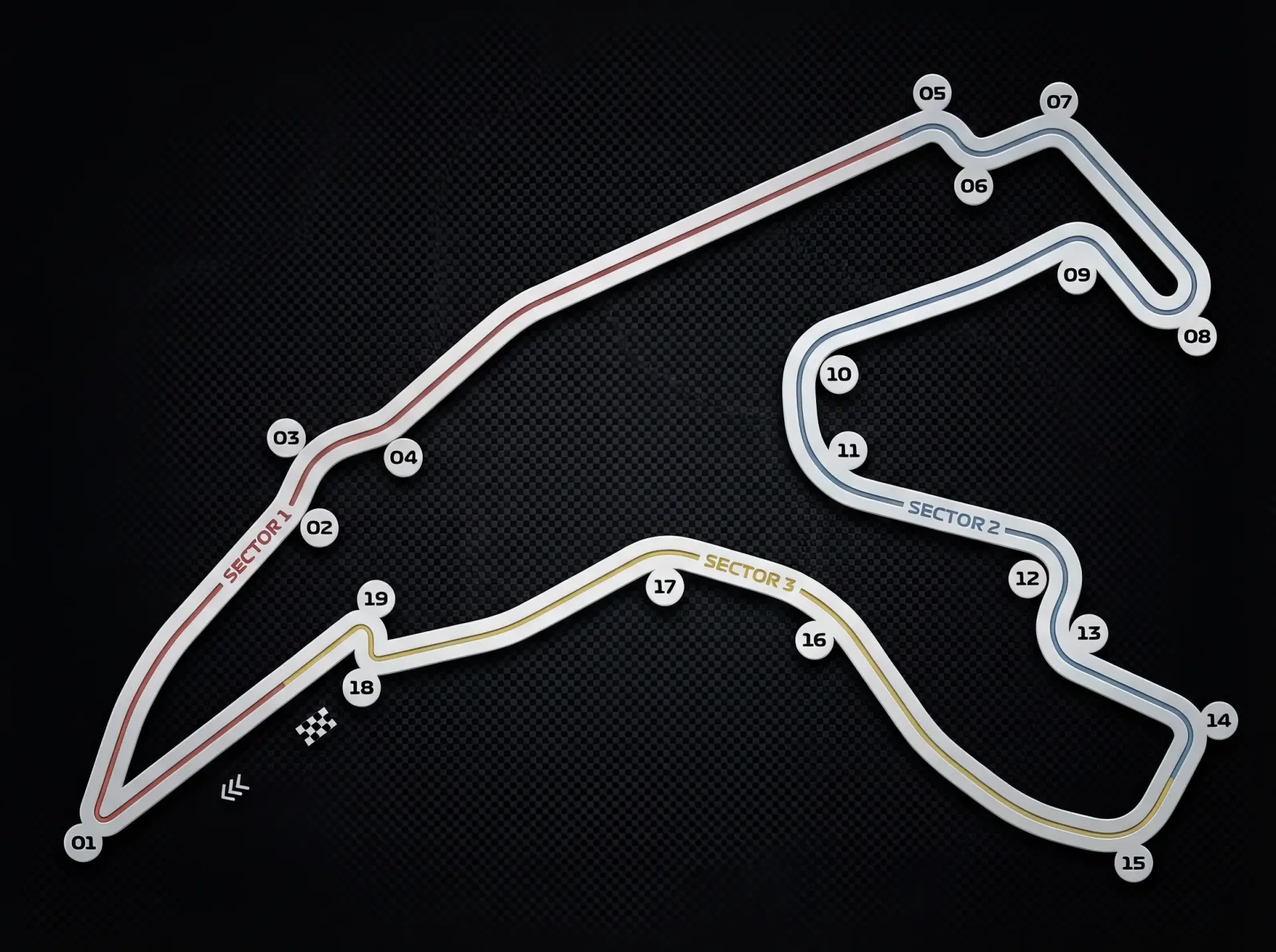
Compare the circuit length, turns, race distance, lap and pole records, driver wins, and elevation details for this Formula 1 track.
7.004 km
19
44
1:44.701
Sergio Pérez
Fastest Q3 lap that secured Grand Prix pole on the applicable layout.
1:40.562
Lando Norris
Michael Schumacher
6 wins
102 m
Racing challenge
Spa is the longest circuit on the current Formula 1 calendar, and its scale shapes every part of the challenge. Drivers descend to Eau Rouge before climbing steeply through Raidillon, then accelerate along the Kemmel Straight toward a sequence of medium- and high-speed corners. Pouhon, Blanchimont and the final chicane demand different combinations of commitment, balance and braking control across the same lap.
The setup decision is a compromise. Lower drag helps on the long straights in the first and final sectors, while downforce supports confidence and tyre performance through the flowing middle sector. The circuit's location in the Ardennes adds another variable: one section can be wet while another remains dry. That makes tyre choice, timing and driver feedback unusually important. Spa can provide passing opportunities after long acceleration zones, so teams must consider both qualifying speed through the corners and how effectively the car can attack or defend on race day.
The length of the lap magnifies every decision. A small error can take more than two minutes to correct on the next attempt, while a change in weather may reach a driver far from the pits. Engineers must interpret conditions across the whole circuit, and drivers need enough confidence to commit through fast sections even when grip is not uniform.
Follow the key corner sequences in lap order and see where drivers gain time, protect momentum and create passing opportunities.
Turn 1
The slow opening hairpin rewards controlled braking and a tidy exit because acceleration continues downhill toward Eau Rouge.
Turns 2 to 4
Cars compress at the bottom of Eau Rouge before climbing steeply through Raidillon. Commitment and balance determine speed onto the Kemmel Straight.
Turns 5 to 7
Heavy braking after the Kemmel Straight creates a passing opportunity before a right-left-right sequence that begins the flowing middle sector.
Turns 10 and 11
The fast double-left places sustained load through the car and asks the driver to carry speed without losing the line for the following corners.
Turns 17 to 19
A high-speed run through Blanchimont ends with heavy braking for the final chicane, where a late move is possible but an error can ruin the lap.
2026 race guide
DRS was replaced by Overtake Mode for 2026. Spa has five Straight Mode zones: the start and finish straight, between Turns 2 and 3, the Kemmel Straight between Turns 4 and 5, between Turns 15 and 16, and between Turns 17 and 18.
The Overtake Detection line is at Turn 19 and activation follows at the exit onto the start and finish straight. Les Combes after the Kemmel Straight and the Bus Stop chicane remain the clearest conventional braking opportunities.
Arguably the most famous sequence of corners in motorsport; a high-speed, downhill-then-uphill sweep.
A thrilling, high-speed, downhill double-apex left-hander.
Mika Häkkinen sensationally passed Michael Schumacher by using backmarker Ricardo Zonta as a pick, going one side while Schumacher went the other in a breathtaking move.
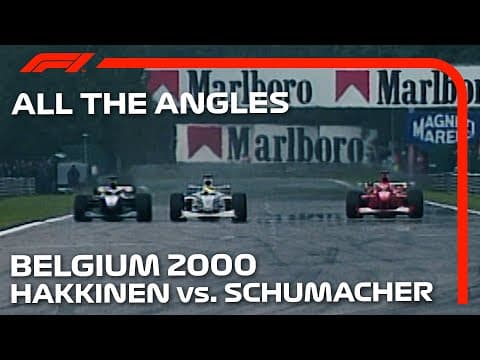 Watch iconic moment on YouTube
Spa hosted Formula 1 in the World Championship's first season in 1950. Safety concerns led to a much shorter reworked circuit and a return in 1983; the modern 7.004 km lap remains the longest on the 2026 calendar.
Circuit de Spa-Francorchamps stands as motorsport's most revered cathedral, a venue where legend and reality intertwine among the rolling hills of the Belgian Ardennes. More than any other circuit, Spa represents the pure essence of racing: a challenge that demands absolute commitment, rewards the brave, and punishes the slightest error with unforgiving severity. Its story spans nearly a century of motorsport evolution, from daredevil races on public roads to modern safety-conscious competition, yet it has never lost its fundamental character as the ultimate test of driver skill and courage.
The genesis of Spa-Francorchamps lies in the aftermath of World War I, when Belgium sought to establish itself as a major player in the emerging world of international motorsport. The concept originated with a group of Belgian automobile enthusiasts who envisioned a race that would showcase both their country's scenic beauty and its industrial capabilities. The location they chose—a triangular route connecting the villages of Spa, Malmedy, and Stavelot through the densely forested Ardennes—would prove to be inspired.
The first race took place on August 11, 1924, using public roads that formed a daunting 14.9-kilometer circuit. This original layout included the legendary corners that would define Spa's character: the plunging descent of Eau Rouge, the blind crests of Radillon and Blanchimont, and the sweeping curves through the forest sections. The circuit's length and challenging nature immediately established it as one of Europe's premier racing venues.
The early races were characterized by their raw, uncompromising nature. Drivers raced on public roads with minimal safety provisions, relying entirely on skill and courage to navigate corners that could easily prove fatal. The circuit's reputation for danger was established early, but so was its status as the ultimate proving ground for racing drivers. Those who mastered Spa were recognized as belonging to motorsport's elite.
During the 1930s, the circuit began hosting the Belgian Grand Prix, attracting the era's greatest drivers and most advanced racing cars. The Silver Arrows of Mercedes-Benz and Auto Union dominated this period, with legendary drivers like Rudolf Caracciola and Bernd Rosemeyer posting remarkable victories. These early Grand Prix races established many of the traditions and characteristics that would define Spa throughout its history.
The post-war period marked Spa's emergence as one of the most prestigious venues in international motorsport. The Belgian Grand Prix became a cornerstone of the World Championship calendar, attracting the sport's biggest names and most advanced machinery. The circuit's fearsome reputation grew alongside its prestige, with the original 14.9-kilometer layout presenting challenges that few other venues could match.
The 1950s and 1960s are often considered Spa's golden age, when giants like Juan Manuel Fangio, Stirling Moss, Jim Clark, and Jackie Stewart battled through the Ardennes forests at speeds that seem inconceivable given the minimal safety provisions. The circuit's character during this era was defined by its extremes: breathtaking speed combined with mortal danger, sublime natural beauty contrasted with the ever-present threat of catastrophe.
Weather played a crucial role in Spa's mystique during this period. The circuit's location in the Ardennes meant that conditions could change rapidly and dramatically, with different sections experiencing entirely different weather simultaneously. Drivers might encounter torrential rain in the forest sections while the start/finish area remained dry, creating additional challenges that separated the exceptional from the merely competent.
The legendary Eau Rouge-Radillon complex gained its reputation during this era as one of motorsport's ultimate tests of courage. Approaching at high speed with minimal visibility over the crest, drivers had to commit completely to a line through the sweeping left-right-left sequence, knowing that any mistake would likely prove fatal. The corner became a defining moment for racing drivers, separating those willing to push the absolute limits from those who weren't.
By the late 1960s, even motorsport's traditionally conservative establishment could no longer ignore Spa's mounting safety concerns. A series of tragic accidents, including the deaths of several prominent drivers, forced a confrontation between the circuit's undeniable racing appeal and its equally undeniable dangers. The situation came to a head in 1970 when drivers threatened to boycott the Belgian Grand Prix unless significant safety improvements were implemented.
The immediate response was a series of modifications to the most dangerous sections, including the installation of additional barriers and the creation of some run-off areas. However, these changes proved insufficient, and by 1971, Formula 1 drivers refused to race at Spa unless more comprehensive modifications were made. The Belgian Grand Prix was removed from the World Championship calendar, beginning a period of exile that would last until 1983.
During this period, circuit management undertook extensive studies and consultations to determine how Spa could be made safer while preserving its essential character. The challenge was enormous: how could one of motorsport's most demanding and dangerous circuits be tamed without destroying what made it special? The answer would require a complete reimagining of the circuit layout while preserving its most iconic sections.
The transformation began in the mid-1970s with the construction of a new, shorter circuit that retained the most famous corners while eliminating some of the most dangerous sections. The new layout measured 6.968 kilometers—still one of the longest on the Formula 1 calendar—and preserved Eau Rouge, Radillon, and other defining features while adding modern safety provisions throughout.
The Belgian Grand Prix returned to the World Championship calendar in 1983, marking the beginning of Spa's renaissance as a modern motorsport venue. The new circuit successfully balanced safety requirements with the challenging character that had made the venue legendary. While purists lamented the loss of some classic sections, the essential spirit of Spa remained intact.
The 1980s races at the renovated circuit immediately reminded everyone why Spa was considered special. The combination of high speeds, challenging corners, and unpredictable weather continued to produce memorable races that showcased driver skill and car performance. Ayrton Senna's masterful victory in the rain-soaked 1985 race established his reputation as a wet-weather genius and demonstrated that the new Spa could still produce transcendent moments.
Throughout the 1990s, Spa consistently delivered some of Formula 1's most exciting races. The circuit's characteristics—long straights for slipstreaming, challenging corners for overtaking, and variable weather conditions—created ideal conditions for close racing and dramatic moments. Michael Schumacher's first victory in 1992 began a love affair between the German driver and the Belgian circuit that would define much of the decade.
The circuit's reputation as a driver's circuit was reinforced during this period, with many competitors citing Spa as their favorite venue. The combination of high-speed sections, technical corners, and natural beauty created an experience that reminded drivers why they had fallen in love with racing in the first place. This sentiment was shared by fans, who consistently ranked the Belgian Grand Prix among the season's highlights.
The new millennium brought additional safety improvements and facility upgrades to Spa-Francorchamps while preserving its fundamental character. The circuit underwent extensive renovations in 2006-2007, including resurfacing, upgraded barriers, expanded run-off areas, and improved spectator facilities. These changes addressed modern safety standards while maintaining the venue's challenging nature.
During this period, Spa produced some of the most memorable races in Formula 1 history. The 2008 Belgian Grand Prix, featuring Lewis Hamilton's controversial victory and subsequent disqualification, demonstrated how the circuit could still create drama and controversy. Similarly, the rain-affected races of 2009 and 2010 showcased Spa's unique ability to reward skill while punishing errors.
The circuit's role in developing driver talent became increasingly recognized during this era. Many of Formula 1's most successful drivers cited their experiences at Spa as crucial to their development, with the venue serving as a proving ground where raw speed alone wasn't sufficient. The combination of technical skill, strategic thinking, and sheer courage required to master Spa separated the exceptional from the merely fast.
Technological advances in safety during this period allowed Spa to maintain its challenging character while reducing the risk of serious injury. Modern barrier systems, improved medical facilities, and enhanced track surfaces meant that drivers could push closer to the absolute limit with greater confidence in their safety.
Recent years have seen Spa-Francorchamps navigate the complex challenges facing modern motorsport venues: balancing historical character with safety requirements, maintaining financial viability, and adapting to changing environmental concerns. The circuit has successfully addressed these challenges while preserving what makes it unique in the Formula 1 landscape.
The 2021 Belgian Grand Prix presented unprecedented challenges when persistent rain prevented any meaningful racing, highlighting how Spa's location in the Ardennes continues to influence events just as it did decades ago. While the non-race was frustrating for fans, it demonstrated the circuit's continued ability to humble even modern Formula 1's sophisticated weather prediction and tire technology.
Recent facility improvements have focused on enhancing the spectator experience while preserving the venue's natural setting. New grandstands offer improved viewing angles, while expanded hospitality facilities cater to international audiences. Careful attention has been paid to integrating these developments with the surrounding forest landscape.
The circuit has also embraced sustainability initiatives, implementing renewable energy systems, forest conservation programs, and carbon offset schemes. These efforts reflect both regulatory requirements and genuine commitment to environmental stewardship of the Ardennes ecosystem.
No discussion of Spa-Francorchamps can ignore the mythology surrounding Eau Rouge and Radillon, perhaps motorsport's most famous corner complex. The steep uphill left-right-left sequence has become synonymous with driver courage and skill, representing the point where racing drivers prove their commitment to speed over self-preservation.
The corner's reputation has been built through decades of memorable moments: drivers taking it flat-out when others lifted, spectacular accidents that demonstrated its unforgiving nature, and countless qualifying laps where thousandths of a second separated the brave from the cautious. The corner has become a benchmark for driver evaluation, with the ability to take Eau Rouge flat-out serving as shorthand for exceptional skill and courage.
Modern Formula 1 cars have largely conquered Eau Rouge's challenge through improved aerodynamics and safety systems, but the corner retains its psychological impact. Current drivers still speak of the corner with reverence, understanding its place in motorsport mythology and their role in continuing its legacy.
Spa's unique microclimate continues to influence racing in ways that separate it from other venues. The circuit's location in the Ardennes creates conditions where rain can fall on one section while others remain dry, forcing teams and drivers to make strategic gambles about tire selection and racing approach. These conditions have produced some of motorsport's most memorable strategic battles.
The circuit's length also influences strategy significantly, with the long lap time meaning that pit stops have greater strategic impact than at shorter venues. Teams must balance the time lost in the pits against the advantage of fresh tires over such a long and demanding circuit. This strategic complexity adds another layer to Spa's appeal for both participants and observers.
Spa-Francorchamps transcends mere sporting venue status to represent something approaching sacred ground for motorsport enthusiasts. The circuit embodies racing's romantic ideals: the challenge of man and machine against natural forces, the reward for courage and skill, and the consequences of overreaching one's abilities.
The venue's influence extends beyond Formula 1 to encompass all forms of motorsport. Sports car racing, touring cars, and motorcycle racing all hold Spa in similar reverence, with victories at the circuit carrying special significance regardless of the category. The annual 24 Hours of Spa endurance race has become one of Europe's premier motorsport events, attracting international attention and top-tier competition.
As Spa-Francorchamps looks toward the future, the primary challenge remains preserving its essential character while adapting to evolving safety, environmental, and commercial requirements. Recent contract extensions guarantee the Belgian Grand Prix's continuation through the late 2020s, providing stability for long-term planning and investment.
The circuit's management continues to explore ways of reducing environmental impact while maintaining world-class racing facilities. Forest conservation programs, renewable energy initiatives, and sustainable transportation options reflect commitment to responsible stewardship of the Ardennes environment.
Future developments will likely focus on enhancing spectator facilities and embracing new technologies while avoiding changes that might compromise the circuit's fundamental character. The challenge will be maintaining Spa's position as motorsport's ultimate test while meeting the evolving demands of modern racing.
Today, Circuit de Spa-Francorchamps remains what it has always been: motorsport's most demanding and rewarding challenge. In an era of increasingly sanitized racing venues, Spa continues to demand absolute commitment from drivers while rewarding skill, courage, and strategic thinking. Its survival and continued relevance stand as testament to the enduring appeal of pure, uncompromising racing and the eternal fascination with humanity's desire to push beyond conventional limits.
Circuit de Spa-Francorchamps is 7.004 km long and has 19 turns. The Belgian Grand Prix runs for 44 laps, covering 308.052 km.
They are connected parts of Spa's famous uphill sequence. Eau Rouge begins at the bottom of the compression, while Raidillon continues the steep climb and crest that follows.
Spa's long lap stretches across a large area of the Ardennes. Rain can reach one part of the circuit before another, so grip and visibility may change within a single lap.
Fact checked and reviewed .