Circuit length
3.337 km
Monaco Grand Prix · Monaco
The Monaco F1 circuit is a 3.337 km street track through Monte Carlo, where 19 corners, elevation changes and nearby barriers reward precision. This guide brings together the circuit map, key statistics, signature corners and the characteristics that make the Monaco Grand Prix distinct.
F1 circuit guide
Circuit de Monaco is a Formula 1 circuit in Monaco associated with the Monaco Grand Prix. Its key figures include a 3.337 km layout, 19 turns, 78 race laps, and 42 metres of elevation change. This guide covers track statistics, lap records, famous corners, iconic Grand Prix moments, and Formula 1 history.
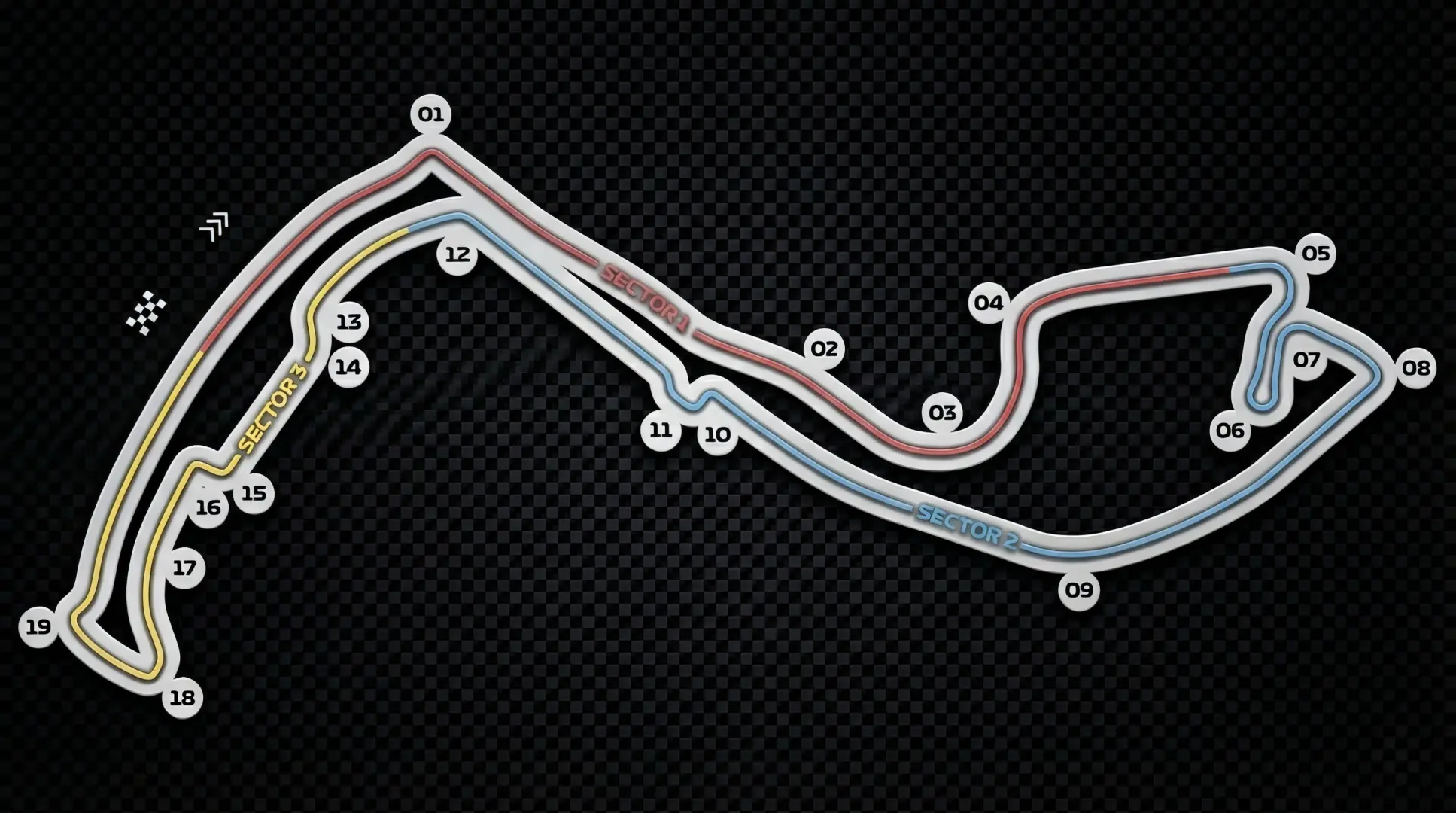
Compare the circuit length, turns, race distance, lap and pole records, driver wins, and elevation details for this Formula 1 track.
3.337 km
19
78
1:12.909
Lewis Hamilton
Fastest Q3 lap that secured Grand Prix pole on the applicable layout.
1:09.954
Lando Norris
Ayrton Senna
6 wins
42 m
Racing challenge
Monaco compresses a complete Formula 1 lap into narrow public roads with almost no margin beyond the racing line. Corners arrive quickly, the straights are short and the barriers punish small errors, so drivers must build confidence without losing accuracy. The Fairmont Hairpin is the slowest point on the lap, while the tunnel, harbour chicane, Swimming Pool complex and climb toward Casino Square create repeated changes in speed, light and elevation.
Teams favour high downforce and mechanical grip because cornering performance matters more here than outright straight-line speed. A stable car helps drivers attack kerbs, rotate through the hairpin and place the tyres precisely beside the walls. The tight layout also makes passing difficult, which increases the value of qualifying position and clean pit-stop execution. Race strategy can still change through traffic, safety-car timing or changing grip, but track position remains unusually important from the start of the weekend to the chequered flag.
The temporary nature of the venue adds to that progression. Grip builds as Formula 1 cars run on roads that normally carry everyday traffic, so drivers continually refine braking points and how closely they can approach the barriers. That evolution makes uninterrupted practice laps valuable and raises the cost of losing confidence before qualifying.
Follow the key corner sequences in lap order and see where drivers gain time, protect momentum and create passing opportunities.
Turn 1
A short run from the grid leads into a tight right-hander where the field compresses on the opening lap. A clean exit is essential for the climb toward Casino Square.
Turns 3 and 4
The circuit continues uphill through a sweeping left before the cars turn across Casino Square. Drivers balance speed with precise placement over a changing road surface.
Turn 6
Formula 1's tightest hairpin demands very low speed, maximum steering lock and careful traction on exit before the narrow run toward Portier.
Turns 9 to 11
Drivers accelerate through the tunnel while their vision adjusts to rapid light changes, then brake heavily for the harbour-side chicane.
Turns 13 to 18
Fast direction changes through the Swimming Pool lead into slower corners where small placement errors can compromise the final run back to the line.
2026 race guide
DRS was replaced by Overtake Mode for the 2026 season. Monaco has no Straight Mode active-aero zones, so the cars remain in their high-downforce cornering configuration around the lap.
The Overtake Detection line is between Turns 16 and 17, with activation between Turns 18 and 19 for the following lap. Conventional passing remains difficult, with Sainte Devote and the Nouvelle Chicane offering the clearest opportunities when a driver can get close enough to attack.
The slowest corner in Formula 1, requiring full steering lock and immense precision.
An iconic, bumpy, and fast right-hander with a blind crest.
Ayrton Senna's qualifying lap was a transcendent moment, where he was an astonishing 1.4 seconds faster than teammate Alain Prost, later describing it as an out-of-body experience.
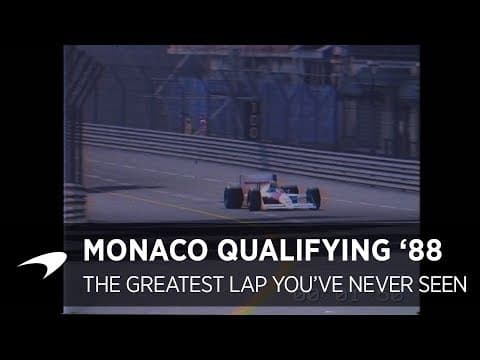 Watch iconic moment on YouTube
The Monaco Grand Prix began on the streets of Monte Carlo in 1929 and joined the first Formula 1 World Championship season in 1950. Its harbour-side route remains a rare test of precision against close barriers.
The Circuit de Monaco was the brainchild of wealthy cigarette manufacturer Antony Noghès, who had set up the Automobile Club de Monaco with some of his friends. The event was organised by Antony Noghès and supported by Prince Louis II through the Automobile Club de Monaco, establishing a royal patronage that continues to this day.
The first Monaco Grand Prix took place on 14 April 1929, marking the beginning of what would become one of the most prestigious and challenging races in motorsport history. William Grover-Williams won the inaugural race driving a Bugatti, for the grand sum of 100,000 French francs.
The original circuit consisted of 12 corners, beginning on Boulevard Albert I before turning right through Saint Devote – named to honour the small Saint Devota chapel which is usually obscured by crash barriers and sponsorship signage on race weekends.
Unlike modern purpose-built racing circuits, Monaco was created entirely on the principality's public roads, winding through the narrow streets of Monte Carlo. This unique characteristic meant that any modifications to the circuit have been closely associated with changes to Monaco's public roads. Unlike purpose-built racing circuits that can be modified independently, alterations to the Circuit de Monaco have typically coincided with urban development or infrastructural changes within the principality.
The race eventually became part of the pre-Second World War European Championship and was included in the first World Championship of Drivers in 1950. It was twice designated the European Grand Prix, in 1955 and 1963, highlighting its growing importance in international motorsport.
Only four local drivers have won a race at the circuit. Louis Chiron did it at the non-championship 1931 Monaco Grand Prix, establishing a tradition of local racing heroes that would continue through the decades.
The circuit was part of the first Formula One World Championship in 1950, with Juan Manuel Fangio taking the victory. This inclusion from the very beginning of the Formula 1 era cemented Monaco's status as one of the sport's most important venues.
It became an annual spectacle (barring wartime and exceptional cancellations) and a pillar of the Triple Crown of Motorsport (alongside the Indianapolis 500 and 24 Hours of Le Mans), establishing its legendary status among racing's most prestigious events.
One of the most significant alterations to the Monaco circuit came in 1963. Originally, the start/finish straight was alongside the harbour and the first corner was the tight and now non-existent Gasworks hairpin. It was switched to its current location in 1963, making Ste Devote the new first corner.
The early 1970s saw the most substantial changes in Monaco's history. For the first time in its history, the Monaco circuit was altered in 1972, as the pits were moved next to the waterfront straight between the chicane and Tabac, and the chicane was moved further forward right before Tabac, becoming the junction point between the pits and the course.
The course was changed again for the 1973 race. The Rainier III Nautical Stadium was constructed where the straight that went behind the pits was, and the circuit introduced a double chicane section that would become one of its most distinctive features.
The circuit gained more Armco in specific points for the next two races, and by 1972, the circuit was almost completely Armco-lined. This represented a major safety upgrade, as the barriers provided crucial protection along Monaco's narrow streets and unforgiving walls.
In 1976 the "Sainte Dévote" and "Antony Noghès" corners were modified: in order to slow down the transit of the cars, curbs and protections were repositioned. It used to be a faster right-hander but it was tightened in 1976, reflecting the ongoing balance between maintaining Monaco's character and ensuring driver safety.
In 1986, thanks to the expansion of the roadway implemented in the chicane area of the port, the chicane itself was modified and made more suitable for modern Formula 1 cars. The Nouvelle Chicane was a revision of the old chicane, made in 1986.
The Gasworks Hairpin was replaced by two corners: La Rascasse, which is made up of two tight right-hand turns, and Anthony Noghès – named after the circuit's original designer. This change eliminated one of the original circuit's most challenging sections while creating new technical challenges.
In 1997, the first "Piscine" corner was modified: the shifting of the track edge protections improved the visibility for the pilots and allowed a higher speed. This section was also given its own name, Louis Chiron, in honor of the Monagesque driver and former race winner.
Saint Devote and La Rascasse were later reworked, pushing the circuit's total length to 2.058-miles, establishing the modern configuration that remains largely unchanged today.
Taking place on the compact streets of Monte Carlo in the Principality of Monaco, the demanding race is considered the ultimate test of driver skill and precision. Engineers carry out about 47 gear changes per lap, indicative of the intricate changes needed to optimize performance for the meandering track.
Its tight corners, narrow streets, and elevation changes have remained largely consistent, providing drivers with a challenging and thrilling experience. This consistency in the track's layout over decades has maintained Monaco's reputation as the most demanding circuit on the Formula 1 calendar.
Monaco's status as a street circuit built on a functioning city creates unique constraints. This means that the track's evolution has mirrored the city's evolution, with racing considerations balanced against the needs of Monaco's residents and infrastructure.
The circuit's narrow width, lack of run-off areas, and proximity to barriers make it fundamentally different from purpose-built racing facilities. These characteristics have remained largely unchanged, preserving Monaco's unique character in an era of increasingly standardized circuit design.
Despite calls for modernization and proposals for changes, Monaco has maintained its essential character while adapting to evolving safety standards. The circuit continues to be one of Formula 1's most prestigious venues, attracting global attention and maintaining its position in the Triple Crown of Motorsport.
Recent discussions about potential modifications reflect ongoing debates about balancing Monaco's historic character with the needs of modern Formula 1, but the circuit's fundamental layout remains largely as it was established in the major reconstructions of the 1970s and 1980s.
From its inception in 1929 as Antony Noghès' ambitious vision to its current status as Formula 1's most glamorous venue, the Circuit de Monaco represents nearly a century of motorsport evolution. Its history reflects not just changes in racing technology and safety standards, but also the broader cultural and social evolution of Monaco itself.
The circuit's story is one of careful preservation of character while adapting to changing times – a balance that has allowed Monaco to remain unique in an increasingly homogenized sporting landscape. Its continued presence on the Formula 1 calendar serves as a bridge between the sport's golden age and its modern era, maintaining traditions that connect contemporary drivers and fans with nearly a century of racing history.
Circuit de Monaco is 3.337 km long. The Monaco Grand Prix runs for 78 laps, producing a race distance of 260.286 km.
The racing surface is narrow, the straights are short and many corners are bordered immediately by barriers. Those constraints leave few places for two Formula 1 cars to run side by side, making qualifying and track position especially valuable.
The Fairmont Hairpin, Casino Square, the tunnel and harbour chicane, the Swimming Pool complex and La Rascasse are among Monaco's defining sections. Together they demand low-speed rotation, commitment and precise car placement.
Fact checked and reviewed .