Circuit length
4.657 km
Barcelona-Catalunya Grand Prix · Spain
The Barcelona F1 circuit is a 4.657 km, 14-turn permanent track in Catalonia. Its mix of long loaded corners, major braking zones and a fast final sector makes Circuit de Barcelona-Catalunya a broad test of aerodynamic balance, tyre management and driver precision.
F1 circuit guide
Circuit de Barcelona-Catalunya is a Formula 1 circuit in Spain associated with the Spanish Grand Prix. Its key figures include a 4.657 km layout, 14 turns, 66 race laps, and 30 metres of elevation change. This guide covers track statistics, lap records, famous corners, iconic Grand Prix moments, and Formula 1 history.
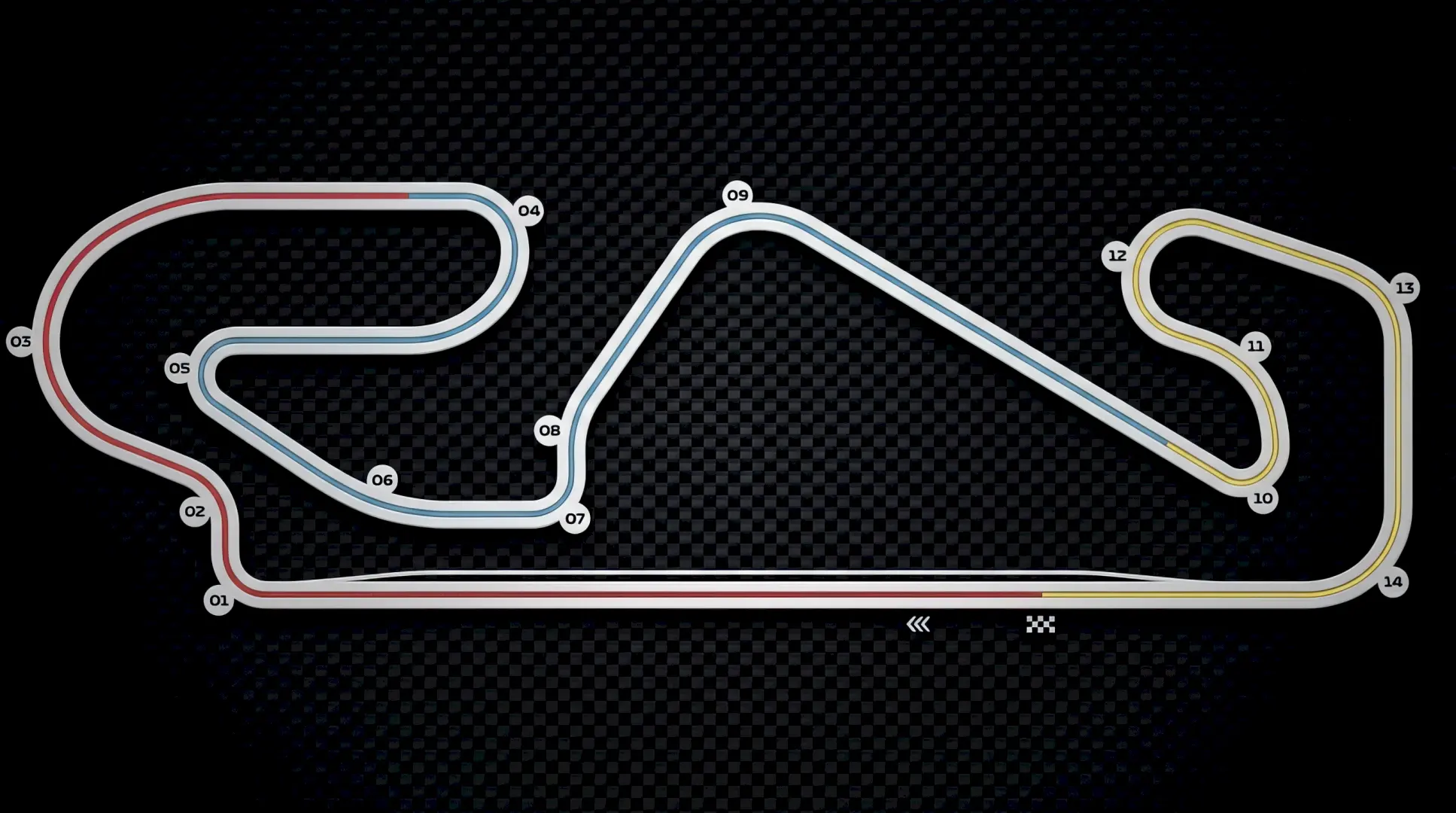
Compare the circuit length, turns, race distance, lap and pole records, driver wins, and elevation details for this Formula 1 track.
4.657 km
14
66
1:15.743
Oscar Piastri
Fastest Q3 lap that secured Grand Prix pole on the applicable layout.
1:11.546
Oscar Piastri
Lewis Hamilton
7 wins
30 m
Racing challenge
Barcelona-Catalunya combines several types of corner in a lap that quickly exposes an unstable or poorly balanced car. The long right-handers at Turns 3 and 4 create sustained lateral load, while the slower Turn 5 and Turn 10 demand braking control and rotation. Turn 9 adds a faster commitment test before the lap enters its final section.
The removal of the final chicane in 2023 restored a faster pair of sweeping corners at Turns 13 and 14. Drivers now need confidence through that sequence because the exit feeds directly onto the main straight. Straight-line efficiency helps create an attack into Turn 1, but teams cannot ignore the downforce and tyre support needed through the circuit's longer corners.
Those competing demands have made the venue a useful measure of overall car performance. Drivers must protect the tyres without giving away too much speed through the loaded sections, then connect the final corners cleanly enough to defend or attack at the end of the pit straight.
Follow the key corner sequences in lap order and see where drivers gain time, protect momentum and create passing opportunities.
Turn 1
The long pit straight ends at a right-left sequence where late braking creates the circuit's clearest overtaking chance.
Turns 3 and 4
Sustained right-hand corners place significant lateral load through the car and reward aerodynamic stability and controlled tyre use.
Turn 5
Drivers brake while the circuit falls away, then need clean rotation and traction before the lap accelerates again.
Turn 9
The fast right-hander asks drivers to trust the car's balance and carry momentum onto the following straight.
Turn 10
A heavy stop leads into the slower final portion of the lap and can provide a secondary passing opportunity.
Turns 13 and 14
The sweeping final corners replaced the former chicane in 2023. Their exit determines speed along the main straight and into Turn 1.
2026 race guide
DRS was replaced by Overtake Mode for 2026. Barcelona-Catalunya has four Straight Mode zones: the pit straight, between Turns 3 and 4, between Turns 5 and 7, and between Turns 9 and 10.
The Overtake Detection line is at Turn 13 and activation begins just before Turn 14 for the following lap. The main straight and Turn 1 remain the strongest passing combination, with Turn 10 providing another braking opportunity.
A long, fast, sweeping right-hander that puts enormous strain on the car's front-left tyre.
A tightened left-hand hairpin that is a key overtaking zone.
On his debut for Red Bull Racing, a teenage Max Verstappen fended off Kimi Räikkönen to become the youngest-ever Formula 1 race winner.
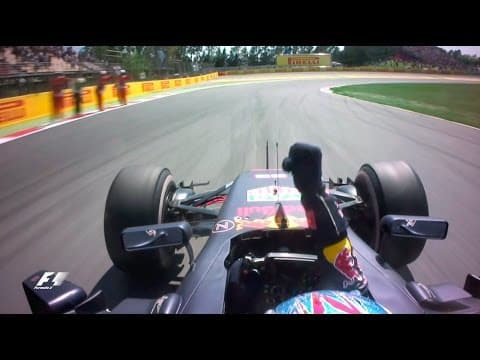 Watch iconic moment on YouTube
Circuit de Barcelona-Catalunya opened in 1991 and hosted Formula 1 within weeks. The final chicane was removed from the Formula 1 layout in 2023; the 2026 event is the Barcelona-Catalunya Grand Prix, while the Spanish Grand Prix moved to Madrid.
The Circuit de Barcelona-Catalunya stands as one of Europe's most significant motorsport venues, serving as both a proving ground for Formula 1 teams and a cornerstone of Spanish motorsport culture. Located in Montmeló, approximately 20 kilometers northeast of Barcelona, this circuit has evolved from an ambitious Olympic project into a world-class racing facility.
The circuit's origins trace back to Barcelona's successful bid to host the 1992 Summer Olympics. As part of the comprehensive infrastructure development for the games, Catalonia's government initiated plans for a modern racing circuit that would put Spanish motorsport on the international map. The project began in 1989 under the direction of architect Hermann Tilke, who would later become renowned for designing numerous Formula 1 circuits worldwide.
Construction took place on rolling hills in Montmeló, with the layout designed to challenge drivers while providing excellent spectator viewing opportunities. The circuit was built to the highest international safety standards of the early 1990s, incorporating features like wide run-off areas and modern barrier systems. The total construction cost reached approximately 40 billion pesetas (roughly $300 million USD at the time).
The Circuit de Barcelona-Catalunya officially opened on September 10, 1991, initially hosting motorcycle racing events and other motorsport competitions. The facility's world-class credentials quickly attracted international attention, and within months of opening, negotiations began to bring Formula 1 to the venue.
The circuit made its Formula 1 debut on May 3, 1992, hosting the Spanish Grand Prix just months before the Barcelona Olympics. The inaugural race proved memorable, with Nigel Mansell claiming victory for Williams-Renault in front of an enthusiastic crowd of approximately 95,000 spectators. The success of this first Grand Prix established the circuit as a permanent fixture on the Formula 1 calendar.
During these formative years, the circuit also began hosting other significant motorsport events, including the Catalan motorcycle Grand Prix and various touring car championships. The facility's versatility and modern amenities made it an attractive venue for teams seeking a reliable European testing location.
Throughout the late 1990s and early 2000s, the Circuit de Barcelona-Catalunya became synonymous with Formula 1 testing. Its convenient location, favorable weather conditions, and comprehensive facilities made it the preferred choice for teams conducting pre-season testing and development work. This period saw the circuit host hundreds of testing days annually, with virtually every Formula 1 team maintaining a regular presence at the facility.
The extensive testing program led to several circuit modifications during this period. In 1994, the chicane at the end of the main straight was modified to improve safety following concerns about closing speeds into Turn 1. Additional safety improvements included upgraded barriers, expanded gravel traps, and enhanced medical facilities.
In 1997, the circuit underwent its first major layout change when the final sector was redesigned. The modification created a more flowing sequence of corners leading to the start/finish straight, improving overtaking opportunities and creating a more challenging technical section for drivers.
As Formula 1 evolved and safety standards continued to advance, the Circuit de Barcelona-Catalunya underwent significant modernization. The most substantial changes occurred between 2007 and 2009, when the circuit received major infrastructure upgrades including expanded paddock facilities, new pit buildings, and improved spectator amenities.
The track surface was completely resurfaced in 2007 using modern asphalt compounds designed to provide consistent grip levels and reduced tire wear. This resurfacing project, combined with updated kerbing and run-off areas, brought the circuit fully in line with contemporary Formula 1 standards.
During this period, the circuit also expanded its role beyond Formula 1, hosting the GP2 Series (now Formula 2), GP3 Series (now Formula 3), and various other junior formulae. The facility's educational programs grew substantially, with the circuit partnering with local technical schools to provide motorsport engineering training.
In 2013, the Circuit de Barcelona-Catalunya achieved a significant milestone by securing the Catalan Grand Prix for MotoGP, making it one of the few venues worldwide to host both Formula 1 and premier motorcycle racing championships. This dual status required additional facility modifications, including specialized motorcycle-specific safety features and altered spectator viewing areas.
The circuit's reputation as a demanding test of both machinery and driver skill continued to grow during this period. Its combination of high-speed corners, tight technical sections, and significant elevation changes created a comprehensive challenge that many considered representative of a complete racing circuit.
Weather began playing an increasingly dramatic role in races during this era, with several memorable wet-weather Spanish Grands Prix producing unexpected results and showcasing the circuit's drainage capabilities, which had been continuously improved since its opening.
The COVID-19 pandemic significantly impacted the circuit's operations in 2020 and 2021, with both Formula 1 and MotoGP events held without spectators or with severely limited attendance. These challenging years prompted circuit management to accelerate planned facility improvements and develop new revenue streams.
In 2021, the circuit underwent another significant corner modification when Turn 10 (formerly the Europcar corner) was redesigned to create better overtaking opportunities. This change, implemented at the request of Formula 1 management, altered the approach to the final sector and aimed to improve the quality of racing.
The circuit has also expanded its role as an automotive testing facility, attracting manufacturers for electric vehicle development and autonomous driving technology testing. These new applications have required additional infrastructure investments, including specialized electrical charging facilities and data acquisition systems.
Looking toward the future, the Circuit de Barcelona-Catalunya continues to evolve with plans for further sustainability improvements, including solar panel installations, water recycling systems, and carbon footprint reduction initiatives. The facility's management has committed to achieving carbon neutrality by 2030, aligning with broader motorsport industry environmental goals.
Today, the Circuit de Barcelona-Catalunya stands as more than just a racing venue; it represents the successful transformation of a regional facility into a globally recognized motorsport institution. Its influence extends beyond hosting major championships to encompass driver development, automotive testing, and motorsport education.
The circuit has witnessed some of Formula 1's most memorable moments, from Michael Schumacher's dominant performances in the early 2000s to Lewis Hamilton's strategic masterclasses in more recent years. For motorcycle racing, it has provided a technical challenge that has crowned worthy MotoGP champions and produced thrilling racing across all categories.
As the Circuit de Barcelona-Catalunya approaches its fourth decade of operation, it continues to adapt and evolve, maintaining its position as one of motorsport's most respected and challenging venues while embracing new technologies and sustainability practices that will define the future of racing.
Circuit de Barcelona-Catalunya is 4.657 km long and has 14 turns on the current Formula 1 layout. The race runs for 66 laps.
Formula 1 returned to the faster final-corner configuration in 2023, removing the slow chicane and restoring the sweeping Turns 13 and 14 that lead onto the main straight.
Turn 1 is the clearest passing opportunity after the long main straight. Turn 10 can also create a chance under heavy braking.