Circuit length
5.807 km
Japanese Grand Prix · Japan
F1 circuit guide
Suzuka International Racing Course is a Formula 1 circuit in Japan associated with the Japanese Grand Prix. Its key figures include a 5.807 km layout, 18 turns, 53 race laps, and 40 metres of elevation change. This guide covers track statistics, lap records, famous corners, iconic Grand Prix moments, and Formula 1 history.
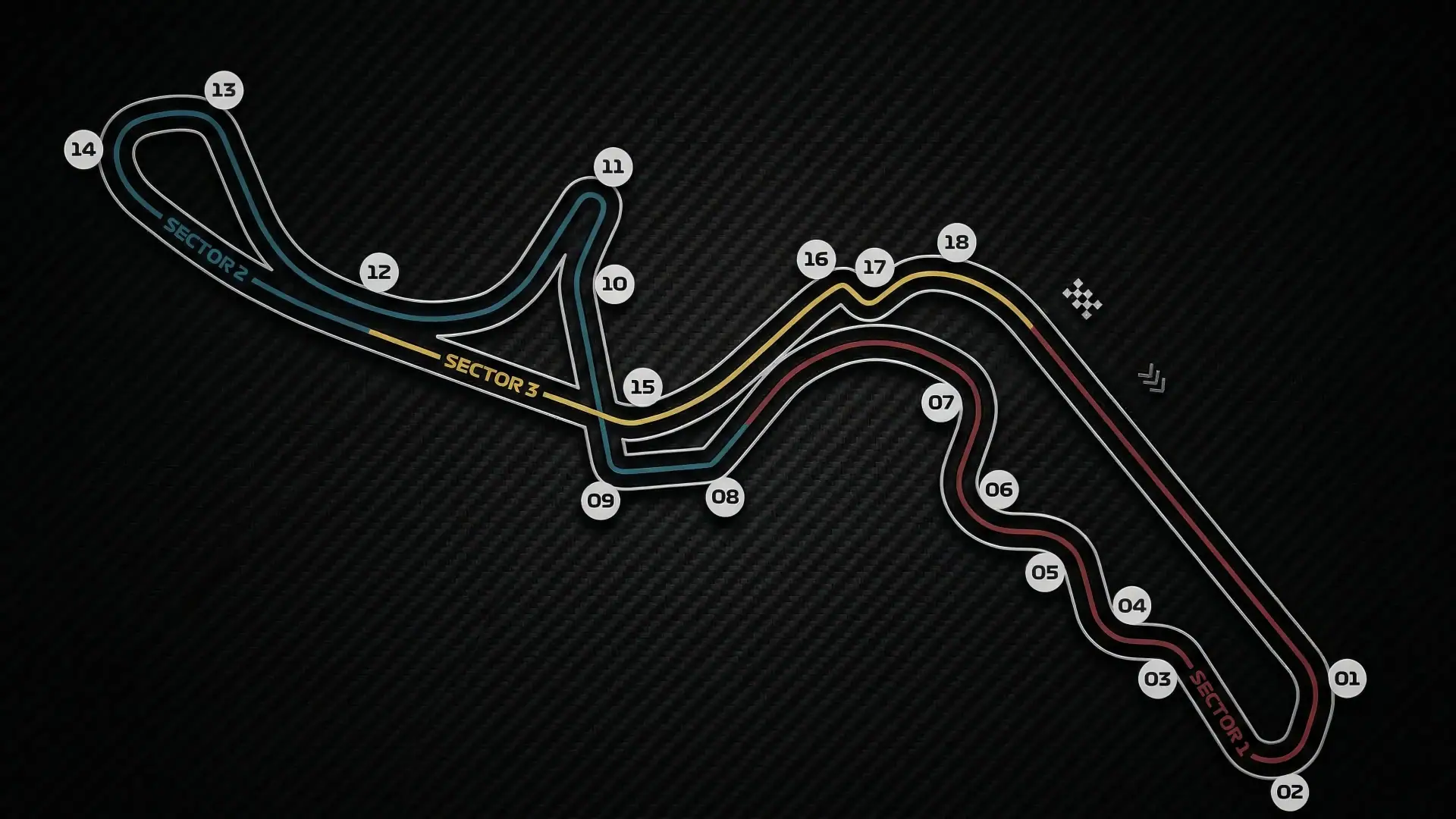
Compare the circuit length, turns, race distance, lap and pole records, driver wins, and elevation details for this Formula 1 track.
5.807 km
18
53
1:30.965
Kimi Antonelli
Fastest Q3 lap that secured Grand Prix pole on the applicable layout.
1:26.983
Max Verstappen
Michael Schumacher
6 wins
40 m
A mesmerizing and rhythmic sequence of left-right-left-right corners that require perfect car balance.
A legendary, dauntingly fast, full-throttle left-hand corner.
Championship rivals and McLaren teammates Alain Prost and Ayrton Senna famously collided at the final chicane, effectively deciding the world title in Prost's favor.
 Watch iconic moment on YouTube
Soichiro Honda decided to develop a new permanent circuit in Mie prefecture in the late 1950s. The Honda founder envisioned more than just another racing circuit - he wanted to create something truly unique that would serve both as a testing facility for Honda's vehicles and as a world-class motorsport venue.
Designed as a Honda test track in 1962 by John Hugenholtz, the Dutch architect who also created Zandvoort and other notable circuits, Suzuka represented a bold departure from conventional track design. Boldly, he opted for a design befitting a children's Scalextric game, with a raised figure-eight design commissioned and financed by Honda founder Soichiro Honda.
Suzuka is one of few circuits in the world to have a figure-eight layout. The track doesn't actually intersect with itself. Instead, the back straight passes over the front section by means of a bridge, creating the distinctive figure-eight configuration that makes Suzuka instantly recognizable.
The circuit measures 5.807 km in length with 18 turns, making it one of the longer tracks on the Formula 1 calendar. At almost 6km and split into two distinct halves, the track is almost unchanged since it was built in 1962. The first half, an intricate technical section, is a flowing combination of corners.
The circuit can be used in three configurations: the full "Grand Prix" circuit, the "East" circuit, and the "West" circuit, providing versatility for different types of racing events and testing purposes.
Initially, the circuit was designed as a test track for Honda, but it quickly became a popular racing venue. Originally used as a test circuit by Honda, the track is now just one component of a giant amusement park and other facilities.
The circuit's reputation grew steadily through the 1960s and 1970s as it hosted various domestic racing events and served its primary purpose as Honda's proving ground for new vehicles and technologies.
In 1982, Honda re-entered the FIM world championships and Suzuka was included on the calendar for the first time. After one year, a programme of renovations commenced, with the ultimate aim of also getting Suzuka added to the Formula One calendar.
These renovations were crucial in bringing Suzuka up to the standards required for Formula 1 racing, including safety improvements and facilities upgrades that would accommodate the sport's demanding requirements.
Despite most people agreeing that Suzuka is a worthy successor to sliced bread in the 'Best Thing' stakes, the Japanese track was a relative latecomer to the F1 calendar, making its first appearance in 1987. The debut was memorable, with Nigel Mansell suffering a crash in qualifying that weekend.
Since its F1 debut, Suzuka has established itself as one of the sport's most challenging and respected venues. Suzuka has exclusively hosted the Japanese Grand Prix every year since 2009, with the only exceptions being in 2020 and 2021 due to the Covid-19 pandemic. It remains one of F1's most influential tracks, and is set to host the Japanese Grand Prix until at least 2029.
John Hugenholtz's masterpiece was Suzuka, representing perhaps the most innovative circuit design of the 1960s. The figure-eight layout challenged conventional thinking about race track design and created a venue that remains unique in Formula 1 to this day.
It has a capacity of 155,000, making it one of the larger Formula 1 venues in terms of spectator accommodation. The circuit continues to serve its dual purpose as both a world-class racing venue and a Honda testing facility, embodying Soichiro Honda's original vision of a facility that could serve multiple functions while maintaining the highest standards of motorsport excellence.
The Suzuka International Racing Course stands as a testament to innovative design and engineering, representing a unique chapter in motorsport history where a manufacturer's testing needs evolved into one of the world's most celebrated racing circuits.