Circuit length
5.451 km
Chinese Grand Prix · China
F1 circuit guide
Shanghai International Circuit is a Formula 1 circuit in China associated with the Chinese Grand Prix. Its key figures include a 5.451 km layout, 16 turns, 56 race laps, and 8 metres of elevation change. This guide covers track statistics, lap records, famous corners, iconic Grand Prix moments, and Formula 1 history.
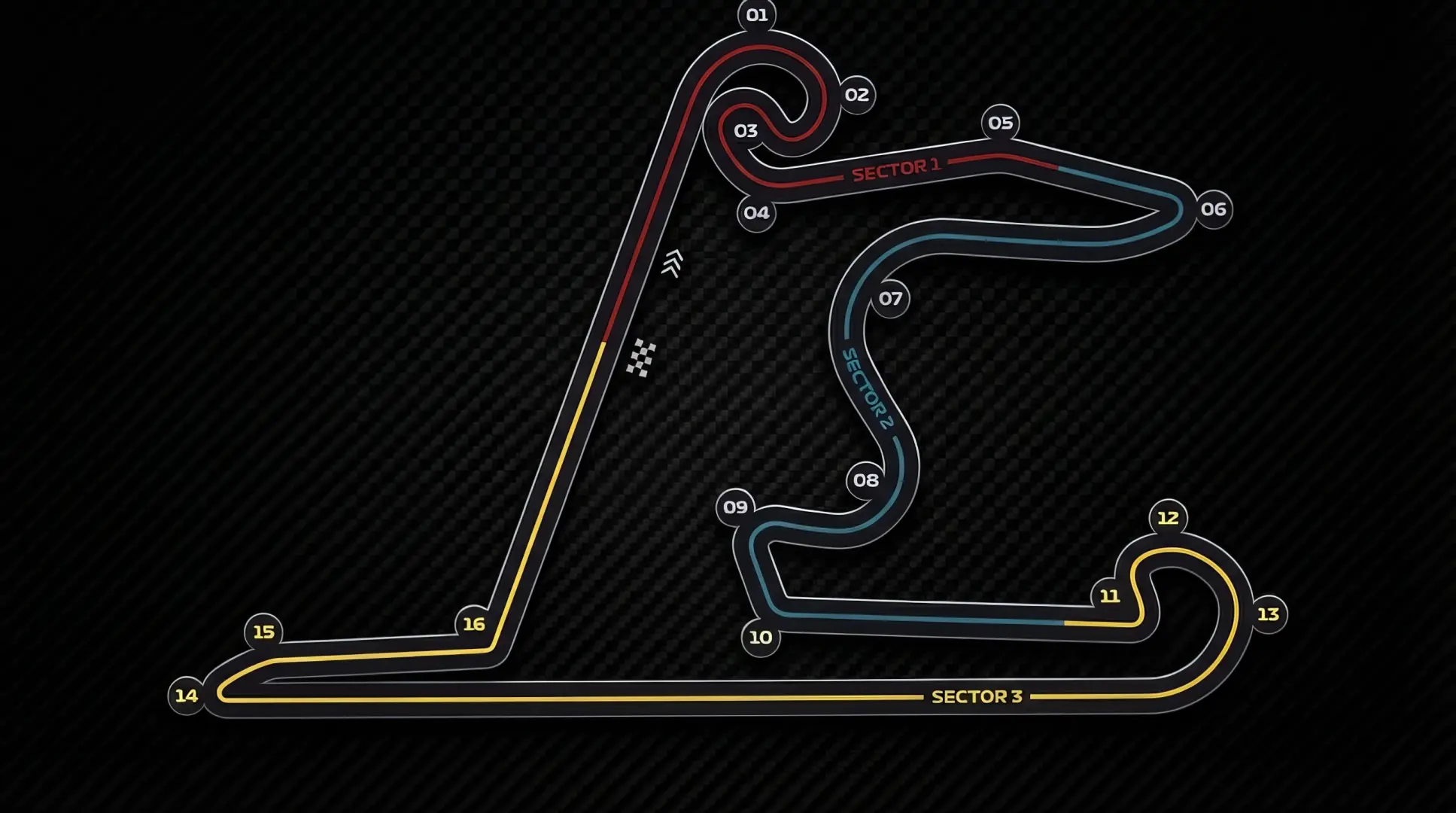
Compare the circuit length, turns, race distance, lap and pole records, driver wins, and elevation details for this Formula 1 track.
5.451 km
16
56
1:32.238
Michael Schumacher
Fastest Q3 lap that secured Grand Prix pole on the applicable layout.
1:30.641
Oscar Piastri
Lewis Hamilton
6 wins
8 m
An iconic and incredibly long, tightening right-hander that leads immediately into a sharp left.
A long, banked right-hander that slingshots cars onto the massive back straight.
A rookie Lewis Hamilton looked set to clinch the world title, but a questionable tyre strategy saw him slide into the gravel on pit entry, his first-ever DNF.
 Watch iconic moment on YouTube
The Shanghai International Circuit emerged from China's ambitious vision to establish itself as a major player in international motorsport and demonstrate its growing economic power to the world. The project began in 1999 as part of China's broader strategy to host prestigious international sporting events, following the successful bid for the 2008 Beijing Olympics.
The Chinese government, recognizing Formula 1's global reach and prestige, committed to creating a world-class motorsport facility that would showcase China's technological capabilities and economic development. Shanghai, as China's commercial and financial hub, was chosen as the ideal location to host the country's first Formula 1 Grand Prix.
The project was initiated by the Shanghai municipal government in partnership with the Shanghai Jiushi Corporation, with significant backing from both local and central government authorities. The scale of investment and ambition reflected China's determination to make a significant impact in the Formula 1 world from the outset.
Bernie Ecclestone, Formula 1's commercial rights holder at the time, was instrumental in facilitating China's entry into Formula 1. The commercial potential of the Chinese market, with its massive population and rapidly growing economy, made it an attractive proposition for Formula 1's global expansion strategy.
The decision to build a permanent circuit rather than utilize a street course demonstrated China's long-term commitment to motorsport. This approach contrasted with many other new Formula 1 venues and reflected the substantial resources available for the project.
The Shanghai International Circuit was designed by Hermann Tilke, the renowned German architect who had already established his reputation with circuits like Sepang in Malaysia. For Shanghai, Tilke was given an unprecedented brief: create a circuit that would be both technically challenging for drivers and visually spectacular for television audiences worldwide.
The 5.451-kilometer circuit was designed around a unique concept inspired by the Chinese character "shang" (上), meaning "up" or "above," which forms part of Shanghai's name. This cultural integration was deliberate, creating a circuit layout that paid homage to Chinese heritage while meeting the highest international motorsport standards.
The track features 16 corners with a distinctive design philosophy that emphasizes dramatic elevation changes, sweeping curves, and multiple racing lines. The most iconic feature is the spectacular back section, featuring a long, climbing curve that creates both a visual spectacle and a significant technical challenge for drivers and their cars.
Construction began in 2002 on a 5.3 square kilometer site located in the Jiading District, approximately 30 kilometers northwest of Shanghai's city center. The location was chosen for its accessibility, development potential, and capacity to accommodate the massive infrastructure required for a modern Formula 1 facility.
The circuit was built to the highest FIA Grade 1 standards, incorporating cutting-edge safety features, state-of-the-art pit facilities, and comprehensive spectator amenities. The project represented one of the largest motorsport facility investments in history at the time, with costs exceeding $300 million.
The paddock and pit complex were designed to accommodate not only Formula 1 but also a wide range of other motorsport categories and automotive events. This flexibility was crucial for ensuring the circuit's viability beyond its primary purpose as a Formula 1 venue.
The Shanghai International Circuit incorporated numerous technological innovations that set new standards for modern motorsport facilities. The pit building, designed with distinctive architectural elements that reflected both modern engineering and Chinese aesthetic principles, featured advanced timing systems, communication networks, and safety equipment.
The track surface utilized specialized asphalt compounds designed to provide optimal grip while maintaining durability under extreme weather conditions. The surface preparation and installation were supervised by international experts to ensure consistency with global Formula 1 standards.
Drainage systems were engineered to handle Shanghai's challenging weather conditions, including heavy rainfall and high humidity. The comprehensive drainage network ensured that racing could continue safely even in adverse weather conditions, a crucial consideration given Shanghai's climate.
The safety systems incorporated the latest FIA requirements, including advanced barrier technologies, run-off areas, and gravel traps positioned strategically around the circuit. Medical facilities were built to international standards, with helicopter landing pads and direct access to major Shanghai hospitals.
The grandstand complex was designed to accommodate over 200,000 spectators, making it one of the largest capacity circuits in Formula 1. The main grandstand provided excellent viewing of the start-finish straight and pit entry, while additional seating areas offered viewing opportunities throughout the circuit.
The inaugural Chinese Grand Prix took place on September 26, 2004, marking a historic moment for both Formula 1 and Chinese motorsport. The race represented China's grand entrance onto the global motorsport stage and demonstrated the country's ability to organize world-class sporting events.
Rubens Barrichello, driving for Ferrari, won the inaugural race in challenging wet conditions that tested both the circuit's drainage systems and the drivers' skills. The race showcased the circuit's technical challenges and its ability to produce exciting racing even in difficult weather conditions.
The event attracted enormous media attention worldwide, with extensive coverage focusing on both the racing action and the broader significance of Formula 1's expansion into the Chinese market. Television audiences reached new heights as Chinese viewers experienced their first Formula 1 Grand Prix.
Attendance exceeded expectations, with enthusiastic crowds demonstrating Chinese interest in international motorsport. The spectacle of Formula 1 racing, combined with the impressive new facilities, created a powerful impression of China's growing international sporting presence.
The successful debut validated the enormous investment and effort required to bring Formula 1 to China. Technical aspects of the race weekend, from timing systems to broadcast facilities, operated flawlessly, earning praise from Formula 1 officials and teams alike.
The first years of the Chinese Grand Prix established Shanghai International Circuit's reputation as one of Formula 1's most technically demanding venues. The unique layout, with its challenging elevation changes and multiple racing lines, created strategic complexity that teams needed time to fully understand.
The 2005 race was notable for Michael Schumacher's masterful wet weather performance, demonstrating how the circuit's characteristics could favor exceptional driving skill. The German's ability to find grip where others struggled showcased the circuit's potential to reward technical excellence.
Weather became a defining characteristic of racing at Shanghai, with several early races featuring mixed conditions that added strategic complexity. Teams had to adapt their approaches to handle everything from blazing sunshine to torrential rain, often within the same race weekend.
The circuit quickly gained a reputation for producing strategic races where tire selection, fuel loads, and pit stop timing could dramatically influence results. The combination of high-speed sections and technical corners created multiple strategic variables that teams needed to optimize.
Chinese motorsport development received significant impetus from Formula 1's presence. The circuit began hosting various domestic and regional racing series, providing development opportunities for Chinese drivers and technical personnel while building local motorsport expertise.
The 2007 race was particularly memorable for Lewis Hamilton's mistake in the pit entry during wet conditions, highlighting how the circuit could catch out even the most talented drivers. Such moments added to Shanghai's growing reputation as a venue where concentration and precision were paramount.
The Shanghai International Circuit represented a crucial element in Bernie Ecclestone's strategy to expand Formula 1 into new markets, particularly in Asia. The commercial arrangements established for the Chinese Grand Prix served as a model for subsequent new venue agreements.
The economic impact of the race on Shanghai and the broader region was substantial from the outset. Hotels, restaurants, and tourism infrastructure benefited significantly from the annual influx of international visitors, validating the government's investment in the facility.
Corporate hospitality and entertainment became major elements of the Shanghai Grand Prix experience. The circuit's facilities were designed to accommodate high-level business entertainment, reflecting the importance of corporate engagement in modern Formula 1.
The race attracted significant international business interest, with many multinational companies using the event as a platform for client entertainment and business development in the Chinese market. This commercial success helped justify the ongoing costs of hosting Formula 1.
Television coverage reached massive audiences throughout Asia, demonstrating Formula 1's potential in emerging markets. The success in China encouraged further expansion into other Asian countries and established the template for Formula 1's global growth strategy.
Local sponsorship and partnership opportunities developed rapidly, with Chinese companies recognizing the marketing value of association with Formula 1. These partnerships provided crucial revenue streams for circuit operations and event promotion.
The circuit underwent continuous technical refinements throughout its first decade, with improvements to track surface, barriers, and run-off areas based on experience and evolving FIA safety standards. These modifications maintained the circuit's essential character while enhancing safety for drivers and marshals.
The 2009 season brought new technical regulations to Formula 1, and Shanghai's challenging characteristics provided an excellent test of the revised rules. The circuit's combination of high-speed sections and technical corners rewarded balanced car designs rather than specialized configurations.
DRS (Drag Reduction System) zones were carefully positioned when the system was introduced in 2011, with the long back straight providing an ideal overtaking opportunity. The implementation demonstrated how modern technology could enhance racing at technically demanding circuits.
The track surface received regular maintenance and selective resurfacing to maintain optimal grip levels and consistency. The original asphalt compound proved durable, but specific sections required attention to ensure continued safety and performance standards.
Weather management systems were enhanced following several rain-affected race weekends. Improved drainage, better weather monitoring, and refined safety procedures ensured that racing could continue safely in Shanghai's changeable weather conditions.
The pit building and paddock facilities were upgraded regularly to accommodate Formula 1's evolving technical requirements and increasing logistical demands. These improvements maintained Shanghai's status as a premier venue while adapting to the sport's changing needs.
The Shanghai International Circuit has produced numerous memorable Formula 1 moments throughout its history. The 2006 race featured one of Michael Schumacher's final victories, demonstrating the German's mastery of difficult conditions and strategic racing.
The 2009 race showcased the circuit's ability to produce dramatic battles, with Sebastian Vettel claiming his maiden Formula 1 victory in challenging conditions. The young German's breakthrough performance highlighted how Shanghai could provide opportunities for new stars to emerge.
The 2011 race was particularly notable for Lewis Hamilton's exceptional wet weather drive, where he recovered from a poor grid position to challenge for victory. The race demonstrated the circuit's potential to reward exceptional driving skill and strategic thinking.
Weather-affected races became a Shanghai specialty, with mixed conditions often creating unpredictable and exciting racing. The 2017 race featured dramatic strategy decisions and multiple lead changes, showcasing the circuit's strategic complexity.
The circuit's unique layout contributed to several first-time winners and breakthrough performances. Young drivers often seemed inspired by the technical challenge and the significance of racing in China, producing memorable drives that launched or enhanced their careers.
Technical failures and dramatic incidents added to Shanghai's legend. The circuit's demanding nature occasionally caught out experienced drivers and teams, creating opportunities for unexpected results and memorable moments.
The introduction of hybrid power units in 2014 brought new dimensions to racing at Shanghai. The circuit's combination of long straights and technical sections perfectly suited the characteristics of the new power units, creating exciting battles between different engine manufacturers.
Energy deployment strategies became crucial at Shanghai, with drivers needing to optimize ERS usage around the demanding 5.451-kilometer lap. The circuit's elevation changes and varied corner speeds created multiple opportunities for strategic energy management.
Lewis Hamilton's dominance during the Mercedes era was evident at Shanghai, but the circuit continued to produce competitive racing and strategic complexity. The 2014 race featured intense battles throughout the field as teams adapted to new technical regulations.
The wider cars introduced in 2017 initially raised concerns about overtaking at Shanghai, but the circuit's multiple racing lines and long DRS zone continued to provide passing opportunities. The strategic elements remained as important as ever.
Tire strategy became increasingly sophisticated at Shanghai, with teams utilizing different compounds and pit stop windows to gain competitive advantages. The circuit's characteristics created multiple viable strategic approaches, adding complexity to race planning.
The final years before the COVID-19 pandemic saw some exceptional racing at Shanghai, with the 2019 race featuring a thrilling battle between multiple teams and demonstrating the circuit's continued ability to produce entertaining Formula 1 racing.
Shanghai International Circuit's unique characteristics have shaped its racing philosophy over nearly two decades. The combination of long straights, sweeping curves, and technical sections creates a comprehensive test of both car and driver capability.
The track's elevation changes add another dimension to the challenge, affecting aerodynamic balance, braking performance, and tire management. Drivers must adapt their techniques throughout the lap to optimize performance across widely varying corner characteristics.
The circuit naturally rewards balanced car setups rather than extreme aerodynamic configurations. Teams must find compromises between straight-line speed and cornering performance, creating opportunities for different competitive approaches.
Weather variability remains a crucial factor, with Shanghai's climate often providing mixed conditions that test team adaptability and driver skill. The comprehensive drainage systems allow racing to continue safely in challenging weather.
The multiple racing lines available at many corners create strategic opportunities and reduce the impact of aerodynamic wake, helping to maintain overtaking possibilities despite modern Formula 1's aerodynamic challenges.
The Shanghai International Circuit has generated substantial economic impact for Shanghai and the broader Yangtze River Delta region. The annual Formula 1 race attracts hundreds of thousands of visitors, supporting hotels, restaurants, and tourism infrastructure throughout the area.
The circuit has served as a catalyst for broader motorsport industry development in China. Training programs, technical education initiatives, and industry partnerships have created skilled workforce opportunities in motorsport and related sectors.
Corporate events and commercial activities generate year-round revenue for the facility. The circuit hosts automotive industry events, corporate entertainment, and commercial filming, maximizing utilization of the world-class infrastructure.
The international profile generated by Formula 1 has attracted additional sporting events and entertainment activities to Shanghai. The circuit's success helped establish Shanghai as a major international events destination.
Property development around the circuit has been significant, with the motorsport facility serving as an anchor for broader commercial and residential development in the Jiading District.
The later years of Shanghai's Formula 1 tenure presented various challenges, including changing audience demographics, economic pressures, and competition from other entertainment options. Circuit management adapted strategies to maintain relevance and attendance.
Ticket pricing and accessibility became important considerations as the Chinese economy evolved. Efforts to make the event more accessible to younger audiences and families helped maintain strong attendance figures.
Competition from other international sporting events required innovative marketing and entertainment offerings. The circuit expanded its entertainment program to create a comprehensive festival atmosphere beyond just the racing.
Environmental considerations became increasingly important, with circuit management implementing sustainability initiatives to reduce the event's ecological footprint. These efforts reflected growing environmental awareness in China and internationally.
The rise of digital entertainment and streaming services required adaptation of promotional and engagement strategies. Social media integration and digital content creation became crucial elements of event promotion and fan engagement.
The COVID-19 pandemic dramatically impacted the Shanghai International Circuit's Formula 1 activities, with the Chinese Grand Prix being cancelled or postponed from 2020 onward due to China's strict pandemic control measures. This suspension represented the longest break in the circuit's Formula 1 history.
The absence of Formula 1 racing created significant economic challenges for the circuit and related businesses. Alternative events and activities were developed to maintain facility utilization and revenue generation during this difficult period.
Maintenance and upgrade programs continued during the suspension, with facility improvements and track modifications prepared for the eventual return of Formula 1. These investments ensured the circuit would remain at the highest international standards.
The circuit continued hosting domestic motorsport events and other activities, maintaining its role as a center for Chinese motorsport development. These activities helped preserve the facility's operational capabilities and local motorsport community.
International motorsport trends and regulations continued evolving during Shanghai's absence, requiring circuit management to monitor developments and prepare for eventual Formula 1 return with updated requirements and standards.
Shanghai International Circuit's impact on Chinese motorsport culture extends far beyond Formula 1. The facility has served as a catalyst for increased interest in all forms of motorsport throughout China, inspiring new participants and fans across various categories.
The economic and cultural significance of the facility helped establish motorsport as a legitimate entertainment and sporting option in China. This cultural acceptance laid the foundation for broader motorsport industry development throughout the country.
Educational initiatives associated with the circuit promoted STEM education and technical careers among young Chinese. The presence of Formula 1 technology and engineering excellence inspired educational programs and career pathways in motorsport and related industries.
The circuit's role in developing Chinese motorsport talent has been substantial, providing opportunities for Chinese drivers, engineers, and technical personnel to gain international experience and expertise.
Local and regional motorsport categories benefited enormously from their association with the Formula 1 facility. The circuit provided exceptional development opportunities and exposure for Chinese motorsport participants.
The Shanghai International Circuit established new standards for motorsport facility technology and design. Many innovations developed for Shanghai influenced subsequent circuit projects worldwide, contributing to the evolution of modern motorsport infrastructure.
The integration of Chinese cultural elements with international technical standards created a unique approach to circuit design that balanced local identity with global requirements. This model influenced other international sporting facility projects.
Environmental technologies and sustainable practices implemented at Shanghai helped establish best practices for large-scale sporting events. These innovations contributed to growing environmental consciousness in motorsport facility management.
The circuit's success in challenging weather conditions demonstrated effective solutions for tropical and subtropical motorsport venues. Drainage systems, surface treatments, and weather management protocols developed at Shanghai influenced other circuits in similar climates.
Communications and broadcast technologies refined at Shanghai contributed to Formula 1's global television production capabilities. The circuit served as a testing ground for new broadcast innovations and fan engagement technologies.
The Shanghai International Circuit remains ready to resume Formula 1 activities when conditions permit. The facility has maintained its FIA Grade 1 license and continues preparing for the eventual return of the Chinese Grand Prix to the Formula 1 calendar.
Infrastructure improvements and modernization continue during the suspension period, ensuring the circuit will meet contemporary Formula 1 standards upon its return. These investments demonstrate continued commitment to hosting world-class motorsport.
The Chinese motorsport market's continued development during Shanghai's Formula 1 absence suggests strong potential for renewed success when international racing returns. Growing domestic interest in motorsport and automotive technology supports optimism for the circuit's future.
Alternative motorsport and entertainment activities have helped maintain the circuit's profile and operational capabilities. These diverse activities provide a foundation for resumed international motorsport hosting when opportunities arise.
The relationship between Formula 1 and the Chinese market remains strategically important for both parties, suggesting strong motivation for resolving the current suspension and returning to regular racing activities at Shanghai.
After fifteen years of Formula 1 racing, Shanghai International Circuit established itself as one of the sport's most technically demanding and strategically complex venues. The circuit's combination of challenging layout, excellent facilities, and professional organization set standards for modern motorsport venues worldwide.
The Shanghai model of government-backed circuit development and operation influenced similar projects in other countries, particularly in Asia and the Middle East. The circuit's success demonstrated the potential for Formula 1 to serve broader economic and cultural development objectives.
The circuit's influence on Formula 1 extends beyond racing, contributing to the sport's global expansion strategy and demonstrating the potential of emerging markets. Shanghai helped establish Formula 1 as a truly worldwide championship with significant presence in Asia.
Technical innovations and safety improvements developed for Shanghai influenced circuit design and safety standards worldwide. The facility served as a testing ground for new technologies and procedures that benefited motorsport globally.
The cultural legacy includes inspiration for Chinese motorsport development and the establishment of China as a significant force in international motorsport. Shanghai proved that emerging markets could successfully host world-class sporting events while contributing to global sporting culture.