Circuit length
4.309 km
São Paulo Grand Prix · Brazil
F1 circuit guide
Interlagos Circuit is a Formula 1 circuit in Brazil associated with the São Paulo Grand Prix. Its key figures include a 4.309 km layout, 15 turns, 71 race laps, and 43 metres of elevation change. This guide covers track statistics, lap records, famous corners, iconic Grand Prix moments, and Formula 1 history.
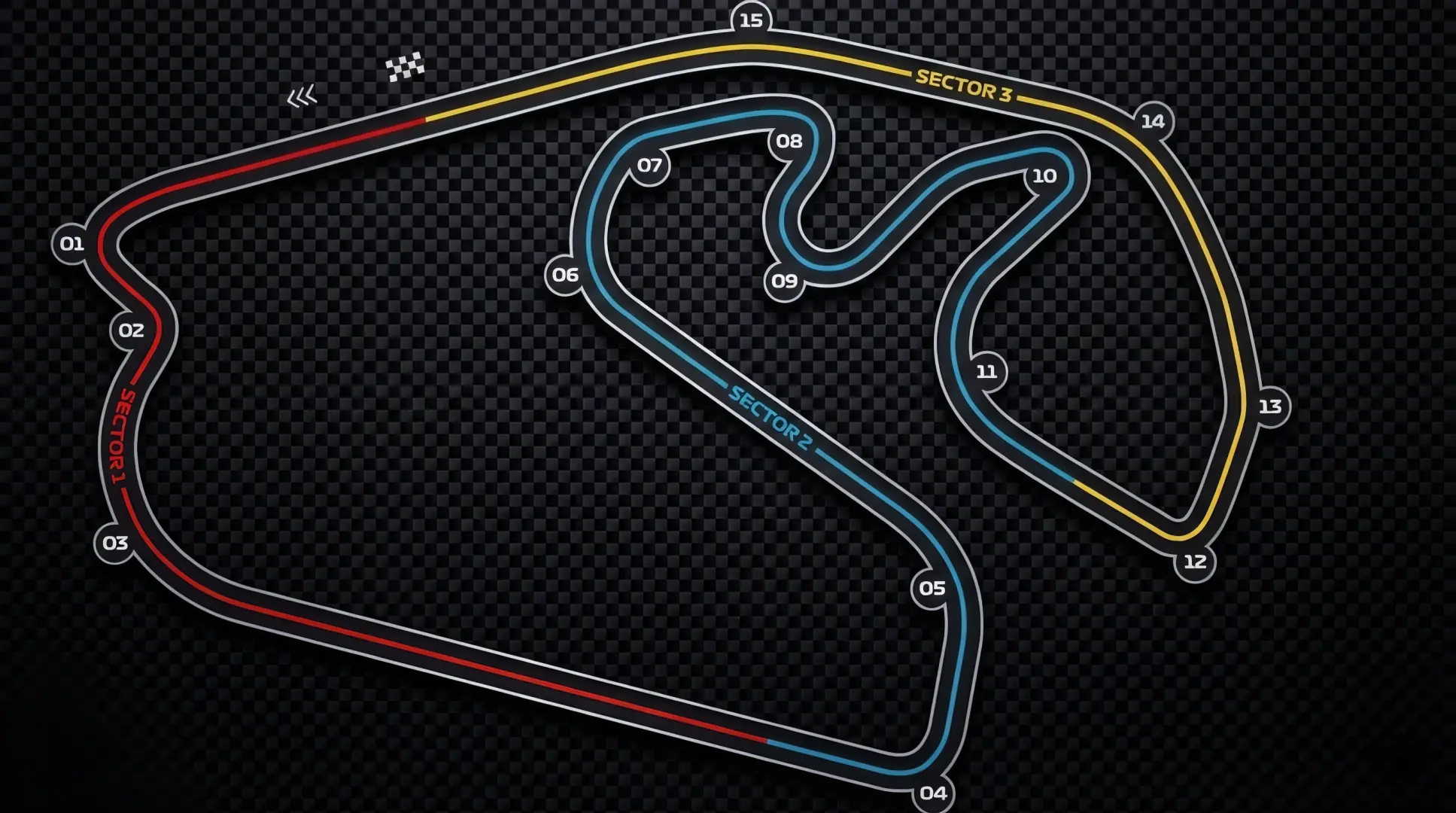
Compare the circuit length, turns, race distance, lap and pole records, driver wins, and elevation details for this Formula 1 track.
4.309 km
15
71
1:10.540
Valtteri Bottas
Fastest Q3 lap that secured Grand Prix pole on the applicable layout.
1:07.281
Lewis Hamilton
Michael Schumacher
4 wins
43 m
A tricky, downhill, off-camber sequence of left-right turns immediately after the start.
The final, slow, uphill left-hander that is crucial for a good run onto the long main straight.
On the final corner of the final lap of the final race, Lewis Hamilton passed Timo Glock to win his first World Championship by a single point in the most dramatic F1 finale ever.
 Watch iconic moment on YouTube
The Autódromo José Carlos Pace, universally known as Interlagos, stands as one of motorsport's most storied and challenging venues. Located in São Paulo, Brazil, this circuit has witnessed decades of Formula One drama, legendary drives, and passionate Brazilian racing culture.
Interlagos was conceived in the 1930s by real estate developers who wanted to create a racing circuit in the Interlagos neighborhood of São Paulo. The original track, designed by French circuit architect Louis Agabashian, opened in 1940 as a massive 7.96-kilometer layout that incorporated public roads. This early configuration was one of the longest circuits in the world, featuring sweeping curves that followed the natural contours of the São Paulo hills.
The circuit's name, meaning "between lakes," reflects its geographic setting between two artificial lakes created for the development. During its early decades, Interlagos primarily hosted local and South American racing events, gradually building its reputation as Brazil's premier motorsport venue.
Formula One first arrived at Interlagos in 1973, marking Brazil's debut on the Grand Prix calendar. The timing was perfect, as it coincided with the rise of Brazilian racing talent, particularly Emerson Fittipaldi, who had already won his first world championship in 1972. Fittipaldi's victory in the inaugural Brazilian Grand Prix at Interlagos created an instant connection between the circuit and Brazilian motorsport pride.
The original F1 layout retained much of the circuit's intimidating character, with drivers facing a grueling test of endurance and skill around the lengthy track. The circuit's elevation changes, fast sweepers, and technical sections quickly established it as one of the most demanding venues on the calendar.
However, safety concerns and the changing nature of Formula One led to the Brazilian Grand Prix being moved to the newer Jacarepaguá circuit in Rio de Janeiro from 1978 to 1989. This period represented a temporary exile for Interlagos from the top tier of international motorsport.
The circuit underwent a major transformation in the 1980s under the guidance of Hermann Tilke. The track was shortened to its current 4.309-kilometer configuration, creating a more compact but equally challenging layout. The redesign maintained the circuit's essential character while improving safety standards and spectator facilities.
Formula One returned to Interlagos in 1990, and the circuit was renamed Autódromo José Carlos Pace in honor of the Brazilian driver who died in a plane crash in 1977. Pace had been a popular figure in Brazilian racing and a winner at Interlagos during its early F1 years.
The 1990s saw Interlagos cement its reputation as a circuit capable of producing exceptional racing. The track's unique characteristics – including significant elevation changes, varying grip levels, and unpredictable weather conditions – created opportunities for dramatic race outcomes.
No discussion of Interlagos is complete without acknowledging Ayrton Senna's profound connection to the circuit. Senna's emotional victory in the 1991 Brazilian Grand Prix, where he could barely climb from his car due to exhaustion and overwhelming emotion, remains one of motorsport's most iconic moments. His struggles with gearbox problems during that race, driving virtually the entire distance in sixth gear, epitomized the warrior spirit that Interlagos seemed to inspire.
Senna's tragic death at Imola in 1994 transformed Interlagos into something approaching a shrine for Brazilian racing fans. The circuit's Senna 'S' curves and the passionate tributes from spectators during race weekends created an atmosphere unlike anywhere else in Formula One.
Contemporary Interlagos presents drivers with a unique set of challenges that have remained largely unchanged despite various modifications over the decades. The circuit's counterclockwise direction, unusual in Formula One, creates specific demands on drivers and car setup. The significant elevation changes – with a height difference of 40 meters around the lap – affect both car balance and engine performance.
The track surface at Interlagos has historically been bumpy and abrasive, creating additional complications for tire strategy and car setup. The circuit's location in São Paulo also means that weather can play a crucial role, with afternoon thunderstorms often transforming race conditions dramatically.
Notable corners include the challenging Senna 'S' at the start of the lap, the long Descida do Lago straight leading into the technical Ferradura corner, and the final sector's combination of corners that can make or break a qualifying lap or race result.
Interlagos has produced numerous classic Formula One races. The 2003 Brazilian Grand Prix stands out for its confusion over the race result, with Giancarlo Fisichella initially declared the winner before Kimi Räikkönen was awarded victory. The 2008 race saw Lewis Hamilton claim his first world championship in the final corners, passing Timo Glock to secure the points needed to beat Felipe Massa.
The 2012 Brazilian Grand Prix provided another championship decider, with Sebastian Vettel recovering from early race damage to finish sixth and claim his third consecutive title. These moments have reinforced Interlagos's reputation as a venue where championships are won and lost.
Interlagos represents more than just a racing circuit; it embodies Brazilian motorsport passion. The enthusiastic spectators, known for their knowledge and vocal support, create an atmosphere that drivers consistently rank among the best in Formula One. The circuit's location in São Paulo, Brazil's largest city, ensures strong attendance and maintains the event's significance in the global racing calendar.
The venue continues to host the Brazilian Grand Prix under a contract that runs through the 2030s, ensuring that this historic circuit will continue to play a vital role in Formula One's future. Recent facility improvements and ongoing maintenance work demonstrate the commitment to keeping Interlagos competitive with modern Formula One standards while preserving its unique character.
Today, Interlagos stands as one of Formula One's most respected venues, combining historical significance with challenging racing characteristics. Its ability to produce unpredictable and exciting races, combined with the passionate Brazilian fanbase, ensures its continued relevance in the sport's landscape. The circuit serves as a testament to Brazilian motorsport's rich heritage and remains a fitting tribute to the drivers like José Carlos Pace and Ayrton Senna who helped establish its legendary status.
The ongoing relationship between Interlagos and Formula One represents one of the sport's most enduring partnerships, built on mutual respect between the circuit's challenging nature and the sport's quest for competitive excellence.