Circuit length
5.278 km
Australian Grand Prix · Australia
F1 circuit guide
Albert Park Circuit is a Formula 1 circuit in Australia associated with the Australian Grand Prix. Its key figures include a 5.278 km layout, 14 turns, 58 race laps, and 8 metres of elevation change. This guide covers track statistics, lap records, famous corners, iconic Grand Prix moments, and Formula 1 history.
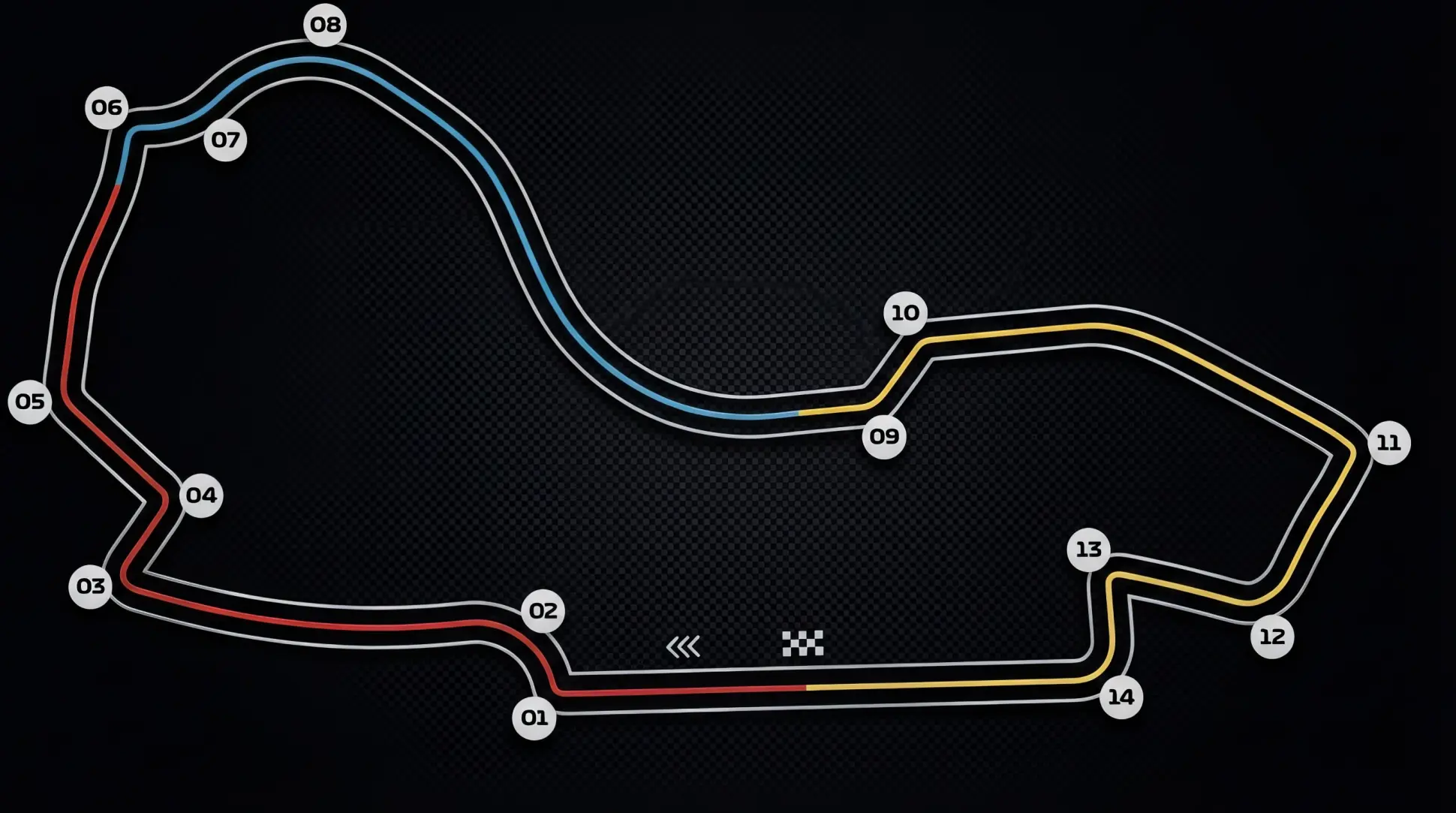
Compare the circuit length, turns, race distance, lap and pole records, driver wins, and elevation details for this Formula 1 track.
5.278 km
14
58
1:19.813
Charles Leclerc
Fastest Q3 lap that secured Grand Prix pole on the applicable layout.
1:15.096
Lando Norris
Michael Schumacher
4 wins
8 m
A high-speed chicane that was reprofiled to be even faster, a true test of downforce and driver commitment.
A quick right-hander that often sees action on the opening lap.
Australian Mark Webber finished a miraculous 5th in his F1 debut driving for the perennial underdog Minardi team, leading to an impromptu, emotional podium celebration.
 Watch iconic moment on YouTube
Albert Park's motorsport history began long before Formula 1 arrived in Melbourne. The park itself, named after Prince Albert, Queen Victoria's consort, was established in the 1860s as a public recreational space surrounding Albert Park Lake. The area's potential for motorsport was recognized in the 1920s when informal racing events began taking place on the park's roads.
The first organized motor racing at Albert Park occurred in 1928, featuring touring car races around the lake's perimeter roads. These early events were modest affairs, but they established the location's credentials as a viable motorsport venue. The natural amphitheater created by the park's topography and the scenic lake setting provided an attractive backdrop for racing.
During the 1930s and 1940s, the venue hosted various Australian motorsport events, including rounds of state and national championships. The races attracted significant local interest and helped establish Melbourne's reputation as a motorsport-friendly city. However, these early events bore little resemblance to the sophisticated international circuit that would later emerge.
The post-World War II period saw renewed interest in motorsport at Albert Park. The Australian Grand Prix, which had been contested at various locations since 1928, occasionally used street circuits in different cities, but the concept of a permanent fixture at Albert Park was still decades away.
Australia's relationship with Formula 1 began in earnest during the 1980s. The Australian Grand Prix was elevated to Formula 1 status in 1985, initially held at the Adelaide Street Circuit. The Adelaide race was successful, but Melbourne harbored ambitions to host the country's premier motorsport event.
Political and commercial factors drove Melbourne's bid for the Australian Grand Prix. The Victorian state government, led by Premier Jeff Kennett, saw the race as a crucial component of their strategy to establish Melbourne as a major international events destination. The economic benefits of hosting a Formula 1 race, including tourism revenue and global television exposure, were compelling arguments for the substantial investment required.
In 1993, a fierce political and commercial battle erupted between Adelaide and Melbourne for the right to host the Australian Grand Prix. Melbourne ultimately secured the race through a combination of financial commitment and the promise of superior facilities. The decision to move the race from Adelaide to Melbourne was controversial and sparked significant debate about the appropriateness of government funding for such events.
The choice of Albert Park as the venue was not without controversy. Environmental groups and local residents opposed the conversion of public parkland into a racing circuit, leading to legal challenges and public protests. The debate centered on the balance between economic benefits and environmental preservation, setting a precedent for similar discussions at other street circuit venues worldwide.
The transformation of Albert Park into a Formula 1-capable circuit required extensive planning and construction. Hermann Tilke, who would later become synonymous with modern Formula 1 circuit design, was not involved in the original Albert Park layout. Instead, the circuit was designed using the existing road network around the lake, with modifications to meet FIA safety and technical requirements.
The 5.303-kilometer circuit incorporated 16 corners, utilizing a combination of existing park roads and purpose-built sections. The layout was designed to provide a challenging mix of high-speed straights, technical corners, and scenic sections around Albert Park Lake. The counterclockwise direction was chosen to optimize the natural flow of the park's road network.
Construction challenges were significant. The temporary nature of much of the infrastructure meant that facilities had to be erected and dismantled annually, similar to other street circuits. However, certain permanent modifications were made to park roads, including widening, resurfacing, and the installation of permanent safety barriers in key locations.
The paddock and pit facilities were designed as temporary structures, requiring extensive setup each year. This approach minimized permanent impact on the park while providing world-class facilities for Formula 1 teams and officials. The main grandstand was positioned to provide optimal viewing of the start/finish straight and the dramatic first corner complex.
Safety considerations were paramount, given the circuit's street nature and proximity to the lake. Extensive barrier systems, catch fencing, and run-off areas were incorporated where possible. The FIA Grade 1 license required careful attention to every aspect of circuit safety, from corner design to marshal positioning.
The inaugural Australian Grand Prix at Albert Park took place on March 10, 1996, marking the beginning of a new era for both the circuit and Formula 1 in Australia. The race served as the season opener, a tradition that would continue for many years and help establish Albert Park's unique character.
The debut race was memorable for several reasons. Damon Hill, driving for Williams-Renault, won the inaugural event in dominant fashion, leading from pole position to checkered flag. The race showcased the circuit's potential for exciting racing, with multiple overtaking opportunities and strategic complexity.
The event was a logistical triumph, demonstrating that Melbourne could successfully host a world-class Formula 1 event. Television coverage reached global audiences, providing extensive exposure for both Melbourne and Australia. The scenic backdrop of Albert Park Lake and the Melbourne skyline created stunning visual imagery that became synonymous with the Australian Grand Prix.
Attendance exceeded expectations, with strong local support demonstrating Australian enthusiasm for Formula 1. The race atmosphere was distinctly different from other Formula 1 venues, combining international sophistication with Australian informality and hospitality.
The success of the inaugural race silenced many critics and established Albert Park as a worthy Formula 1 venue. The event's economic impact was significant, providing validation for the substantial public investment required to bring the race to Melbourne.
The late 1990s were crucial in establishing Albert Park's reputation and traditions. The circuit quickly became known for producing dramatic season openers, with the combination of new cars, fresh driver lineups, and circuit characteristics often creating unpredictable racing.
The 1997 race was particularly notable for a dramatic multi-car accident at the first corner involving several top drivers. This incident highlighted both the excitement and risks associated with the circuit's challenging opening sequence. The race also featured strong performances from local favorite Mark Webber in lower categories, building Australian interest in motorsport.
Weather became a defining characteristic of racing at Albert Park. Melbourne's changeable autumn weather often created strategic complexity, with teams forced to adapt to varying conditions throughout race weekends. Several races featured mixed conditions, adding an extra dimension to the sporting challenge.
The circuit's unique scheduling as the season opener created specific challenges and opportunities. Teams arrived with new cars and limited testing, often leading to reliability issues and unexpected results. This unpredictability became part of Albert Park's charm and contributed to memorable racing moments.
Local motorsport development benefited significantly from Formula 1's presence. The circuit hosted various support categories, providing opportunities for Australian drivers to compete on home soil in front of international audiences. The event became a showcase for Australian motorsport talent and technical capability.
The early 2000s saw Michael Schumacher and Ferrari dominate Formula 1, but Albert Park often provided exceptions to this rule. The circuit's characteristics seemed to suit different cars and drivers, creating opportunities for surprise results and dramatic racing.
The 2001 race was particularly memorable, featuring intense battles between multiple teams and drivers. The strategic complexity of the circuit, combined with Melbourne's variable weather, created racing that was both tactically sophisticated and visually spectacular.
Schumacher's eventual victories at Albert Park were hard-earned, often requiring exceptional drives to overcome circuit-specific challenges. The German driver's adaptability was evident in his approach to the unique demands of street circuit racing combined with the high-speed sections around the lake.
The period also saw significant infrastructure development at Albert Park. Permanent improvements to facilities enhanced the spectator experience while maintaining the circuit's temporary character. Television production capabilities were upgraded to better showcase the scenic venue to global audiences.
Australian drivers continued to feature prominently in support categories, with the circuit serving as a launching pad for international careers. The presence of Formula 1 at Albert Park inspired a generation of Australian motorsport participants and fans.
The mid-2000s brought important safety enhancements to Albert Park. Following various incidents at street circuits worldwide, the FIA implemented stricter safety requirements that necessitated modifications to the circuit layout and infrastructure.
Barrier positions were optimized, run-off areas were expanded where possible, and corner designs were refined to improve safety margins. These changes maintained the circuit's essential character while reducing risk for drivers and marshals.
The 2009 race marked a significant milestone with the introduction of new technical regulations in Formula 1. Albert Park's challenging nature provided an excellent test of the new rules and their impact on racing quality. The race featured close competition and demonstrated the circuit's ability to adapt to Formula 1's evolving technical landscape.
Sustainability initiatives began to emerge during this period, with circuit organizers implementing environmental programs to minimize the event's ecological impact. These efforts addressed ongoing concerns about motorsport's environmental footprint and demonstrated responsible stewardship of the parkland venue.
The global financial crisis of 2008-2009 created challenges for many Formula 1 venues, but Albert Park's strong government backing and economic impact ensured its continued place on the calendar. The race's contribution to Melbourne's tourism and international profile was increasingly recognized.
The 2010s witnessed significant evolution at Albert Park, both in terms of racing quality and facility development. The introduction of DRS (Drag Reduction System) in 2011 enhanced overtaking opportunities at the circuit, particularly along the long back straight toward turn 3.
The 2014 race marked Formula 1's transition to hybrid power units, with Albert Park serving as the debut venue for the new technology. The quieter engines initially drew mixed reactions from spectators, but the improved efficiency and technological sophistication were eventually embraced.
Lewis Hamilton's dominance during the Mercedes era was evident at Albert Park, but the circuit continued to produce memorable moments and competitive racing. The 2016 race featured a dramatic opening lap incident, while 2017 saw intense battles between multiple teams as Formula 1's competitive balance improved.
Infrastructure continued to evolve, with improvements to spectator facilities, media centers, and team accommodations. The circuit maintained its unique character while adapting to Formula 1's increasing technical and logistical demands.
The introduction of wider cars in 2017 initially raised concerns about overtaking at Albert Park, but the circuit's multiple strategic elements continued to provide racing opportunities. Team strategies became increasingly sophisticated, utilizing different tire compounds and pit stop windows to create competitive advantages.
Albert Park's unique characteristics have shaped its racing philosophy over more than two decades. The combination of high-speed sections, technical corners, and strategic complexity creates a distinctive challenge that rewards both driver skill and team strategy.
The circuit's temporary nature means that track conditions evolve significantly throughout each weekend. Limited practice time and changing grip levels create additional variables that teams must manage. This unpredictability has contributed to many memorable races and unexpected results.
The scenic setting around Albert Park Lake provides one of Formula 1's most beautiful backdrops. The juxtaposition of high-speed racing with serene parkland creates a unique atmosphere that distinguishes Albert Park from other Formula 1 venues.
Weather variability remains a crucial factor, with Melbourne's changeable autumn conditions often influencing race outcomes. Teams must prepare for everything from bright sunshine to rain showers, adding strategic complexity to an already challenging weekend.
The circuit's layout naturally creates several potential overtaking zones, though successful passes often require careful planning and precise execution. The combination of long straights and technical sections rewards both aerodynamic efficiency and mechanical grip.
Albert Park has produced numerous memorable Formula 1 moments throughout its history. The 2001 race featured one of the closest finishes in the circuit's history, with multiple lead changes in the final laps creating dramatic television coverage.
The 2010 race showcased the circuit's ability to create strategic complexity, with different tire strategies and safety car periods creating multiple racing scenarios within a single event. The race demonstrated how Albert Park rewards tactical flexibility and quick decision-making.
Weather-affected races have provided some of the circuit's most memorable moments. Mixed conditions have created opportunities for inspired drives and strategic masterclasses, with several races featuring dramatic swings in competitive fortunes.
The circuit has also witnessed several first-time winners and breakthrough performances. Young drivers often seem to find extra motivation racing in Melbourne, perhaps inspired by the enthusiastic Australian crowds and the season-opening significance.
Technical failures and dramatic incidents have added to Albert Park's legend. The circuit's challenging nature has occasionally caught out even the most experienced drivers and teams, creating opportunities for unexpected heroes to emerge.
The COVID-19 pandemic provided an unexpected opportunity for significant circuit modifications at Albert Park. With the 2020 race cancelled and uncertainty surrounding the 2021 event, circuit organizers undertook major layout changes designed to improve racing and modernize facilities.
The most significant changes involved turns 1, 3, 6, 9, and 10, with modifications aimed at creating additional overtaking opportunities and improving race flow. Turn 1 was widened, while the chicane at turns 9-10 was removed and replaced with a faster, flowing corner sequence.
These changes represented the most significant layout modifications since the circuit's inception. The alterations were designed in consultation with Formula 1 and the FIA to enhance racing quality while maintaining Albert Park's essential character and safety standards.
The modifications also included infrastructure improvements, with upgraded facilities for teams, media, and spectators. Permanent improvements were made to reduce annual setup time and costs while enhancing the overall event experience.
The 2022 race, which marked the return of Formula 1 to Albert Park after a two-year absence due to COVID-19, showcased the success of these modifications. The racing was notably more exciting, with increased overtaking opportunities and closer competition throughout the field.
Albert Park's impact on Australian motorsport culture extends far beyond Formula 1. The circuit has served as a catalyst for increased interest in all forms of motorsport throughout Australia, inspiring new participants and fans across various categories.
The economic impact on Melbourne and Victoria has been substantial, with the race generating significant tourism revenue and international exposure. The event has become integral to Melbourne's identity as a major events city, alongside the Australian Open tennis and Melbourne Cup horse racing.
Educational initiatives associated with the circuit have promoted STEM education and technical careers among young Australians. The presence of Formula 1 technology and engineering excellence has inspired educational programs and career pathways in motorsport and related industries.
The circuit's role in developing Australian Formula 1 drivers cannot be overstated. Home race opportunities have provided crucial experience and exposure for Australian talent, contributing to the success of drivers like Mark Webber and Daniel Ricciardo on the international stage.
Local motorsport categories have benefited enormously from their association with the Formula 1 event. Support races at Albert Park provide exceptional exposure and development opportunities for Australian drivers, teams, and technical personnel.
As a circuit located within public parkland, Albert Park has faced ongoing scrutiny regarding environmental impact. Circuit organizers have implemented comprehensive environmental management programs to minimize ecological disruption and demonstrate responsible stewardship.
Sustainability initiatives have evolved significantly over the years, encompassing waste reduction, energy efficiency, and carbon footprint minimization. The temporary nature of much of the infrastructure actually provides environmental benefits, as permanent development is minimized.
Tree protection and park restoration programs ensure that the natural environment is preserved and enhanced. The circuit's design deliberately avoids sensitive ecological areas while utilizing existing road infrastructure to minimize environmental disturbance.
Wildlife management programs protect native species during the event period, while post-event restoration ensures that parkland returns to its natural state quickly. These efforts have helped maintain public support for the continued use of Albert Park as a motorsport venue.
The circuit has increasingly embraced renewable energy sources and sustainable practices, reflecting both regulatory requirements and genuine commitment to environmental responsibility. These initiatives serve as a model for other street circuits and temporary venues worldwide.
Albert Park's future appears secure as part of Formula 1's long-term calendar, with contract extensions ensuring the race's continuation well into the future. This stability provides opportunities for continued investment in facilities and infrastructure improvements.
Planned developments include further enhancements to spectator facilities, with improved viewing areas and amenities designed to enhance the fan experience. These improvements will maintain Albert Park's reputation as one of Formula 1's premier venues for spectator engagement.
Technological integration will continue to evolve, with advanced timing systems, enhanced television production capabilities, and improved connectivity for teams and spectators. These developments will ensure Albert Park remains at the forefront of Formula 1's technological advancement.
Sustainability initiatives will expand further, with ambitious targets for carbon neutrality and environmental stewardship. The circuit aims to serve as a model for responsible major event management in sensitive environmental locations.
The relationship with Melbourne and Victoria will continue to strengthen, with the race remaining central to the region's major events strategy. Economic impact studies consistently demonstrate the race's value, ensuring continued government and community support.
After more than 25 years on the Formula 1 calendar, Albert Park has established itself as one of the sport's most successful and distinctive venues. The circuit's combination of challenging racing, spectacular scenery, and exceptional organization has set standards for other street circuits worldwide.
The Melbourne model of combining government support, commercial partnership, and community engagement has been studied and replicated by other cities seeking to host major motorsport events. Albert Park's success demonstrates the potential for motorsport to serve broader economic and cultural objectives.
The circuit's influence on Formula 1 extends beyond racing, contributing to the sport's global growth and appealing to diverse audiences. The Australian Grand Prix has helped establish Formula 1 as a truly worldwide championship, with Albert Park serving as a gateway to the Asia-Pacific region.
Technical innovations developed for Albert Park have influenced circuit design and safety standards worldwide. The temporary venue model has been refined and adapted for use at other locations, demonstrating the circuit's broader contribution to motorsport infrastructure development.
The cultural legacy includes inspiration for countless Australian motorsport participants and the establishment of Melbourne as a major international motorsport destination. Albert Park has proven that vision, commitment, and careful planning can create world-class sporting venues that serve multiple community objectives while delivering exceptional entertainment and competition.